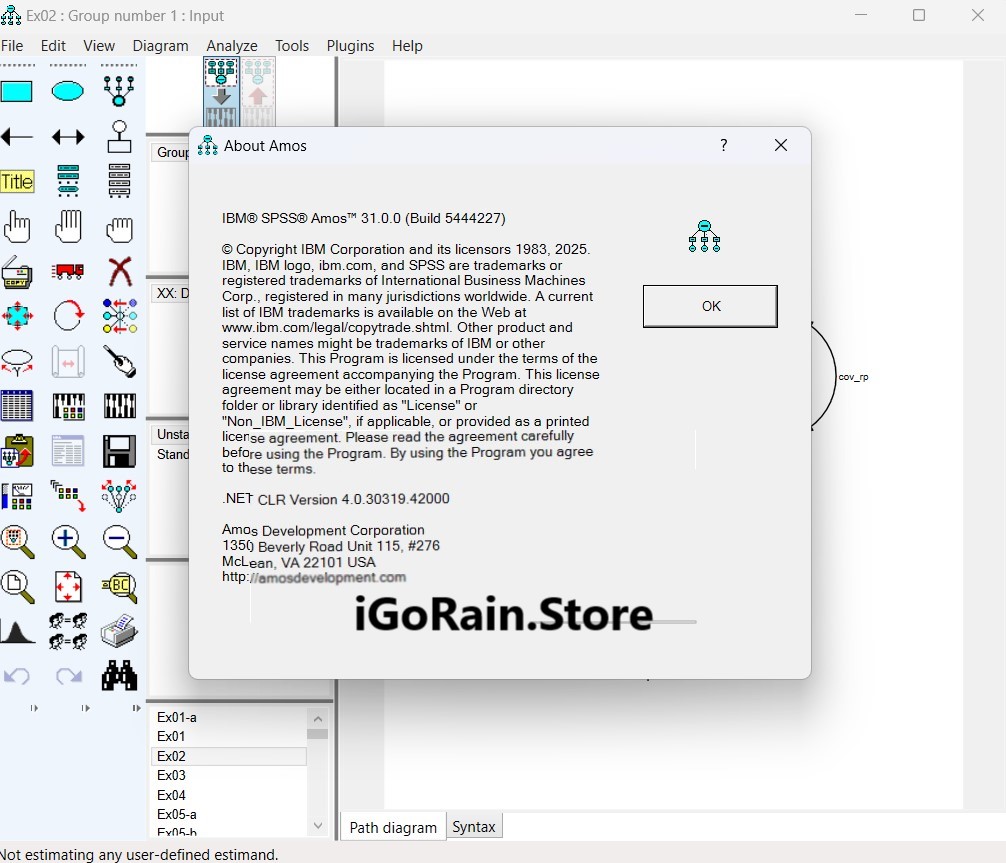
Description
IBM SPSS Amos Review: The Complete Structural Equation Modeling Solution for Researchers and Data Analysts
In the world of modern research, data-driven decision-making is no longer optional Download IBM SPSS Amos 31.0.0. Whether you’re studying human behavior, analyzing market trends, or validating theoretical frameworks, the ability to model complex relationships is essential. IBM SPSS Amos is one of the most trusted tools in this space, providing advanced structural equation modeling (SEM) capabilities within a visual and intuitive interface.
This review explores the software in depth—its features, IBM SPSS Amos 31 download performance, real-world applications, practical benefits, and overall value—so you can determine whether IBM SPSS Amos deserves a place in your research toolkit.
Introduction
IBM SPSS Amos 31 Crack Download Amos (Analysis of Moment Structures) is a specialized module designed for structural equation modeling, confirmatory factor analysis, and path analysis. It is widely used in academic research, social sciences, psychology, education, marketing analytics, and business intelligence.
Unlike traditional statistical programs that rely heavily on coding or mathematical expressions, Amos offers a visual diagram-based modeling environment, allowing users to draw models and instantly test their theoretical assumptions. This visual approach makes SEM more accessible to beginners while providing advanced analytical depth for experienced researchers.
The result is a software platform that enhances model transparency, improves workflow efficiency, and delivers robust analysis capabilities that align with rigorous scientific standards.
Key Features of IBM SPSS Amos 31.x
1. Visual Structural Equation Modeling
One of the signature strengths of IBM SPSS Amos is its drag-and-drop visual model builder. Users can:
-
Create complex models by drawing paths
-
Link latent and observed variables
-
Add error terms, covariances, and regression weights
-
Visually inspect model structure before running analysis
This eliminates the need for advanced coding knowledge and makes SEM more user-friendly.
2. Support for Latent Variable Modeling
Amos excels at handling latent constructs such as personality traits, brand perception, job satisfaction, and academic performance. It offers:
-
Confirmatory factor analysis
-
Multi-factor latent structure creation
-
Robust validation tools for theoretical constructs
This is especially valuable in fields like psychology, education, HR analytics, and marketing research.
3. Maximum Likelihood, Bayesian, and Alternative Estimation Methods
Amos provides multiple estimation techniques to match different research requirements:
-
Maximum Likelihood (ML)
-
Generalized Least Squares (GLS)
-
Bayesian estimation
-
Bootstrap and Monte Carlo simulations
These give researchers flexibility to handle different sample sizes, distribution assumptions, and model complexities.
4. Model Fit Assessment Tools
Model fit is the cornerstone of SEM. IBM SPSS Amos includes comprehensive indicators such as:
-
Chi-square statistics
-
RMSEA
-
CFI
-
TLI
-
NFI
-
GFI
These metrics help researchers determine how well the theoretical model aligns with observed data.
5. Data Imputation and Missing Value Handling
Amos includes advanced techniques for:
-
Multiple imputation
-
Missing at random (MAR) frameworks
-
Bias reduction through estimation methods
This significantly improves data quality and model reliability in real-world scenarios.
6. Bootstrap and Resampling Techniques
Researchers can perform:
-
Confidence interval bootstrapping
-
Standard error estimation
-
Bias-corrected confidence intervals
These methods improve robustness when working with small samples or complex models.
7. Integration with IBM SPSS Statistics
Amos works seamlessly with SPSS Statistics, enabling users to:
-
Import prepared datasets
-
Clean and transform variables in SPSS
-
Expand their analysis with SEM modeling
This tight integration makes the workflow smooth and efficient.
Practical Use Cases
To understand the real value of IBM SPSS Amos, it helps to examine how researchers and professionals use it in practice.
1. Academic Research and Thesis Work
Students and researchers in universities worldwide use Amos to validate research hypotheses. Common applications include:
-
Testing behavioral theories
-
Confirming psychological constructs
-
Validating survey-based research
-
Analyzing causal relationships
Its visual modeling approach helps students understand SEM concepts while delivering professional-grade results.
2. Marketing and Consumer Behavior Analysis
Marketing analysts rely on IBM SPSS Amos for:
-
Measuring brand loyalty and customer satisfaction
-
Modeling purchase intention
-
Understanding relationships in consumer perception data
It helps organizations translate survey data into actionable insights.
3. HR Analytics and Organizational Behavior Studies
Amos supports study designs that measure:
-
Employee engagement
-
Job satisfaction
-
Leadership impact
-
Performance evaluation
HR professionals can validate organizational frameworks and support data-driven decisions.
4. Educational Research and Learning Outcome Studies
Education researchers use Amos to:
-
Evaluate student learning models
-
Analyze teaching effectiveness
-
Validate curriculum-based frameworks
SEM helps ensure the accuracy and reliability of educational measurements.
5. Healthcare and Psychological Research
In medical and clinical research, SEM helps explore:
-
Patient behavior patterns
-
Health outcome predictors
-
Clinical intervention models
Amos allows complex relationships to be tested systematically.
Performance Analysis
IBM SPSS Amos is recognized for its stability, precision, and computational power. Here’s how it performs in real-world environments:
Speed and Efficiency
-
Fast model estimation even with large datasets
-
Efficient handling of complex models
-
Optimized for both small and large sample sizes
Researchers often highlight how quickly Amos produces results compared to competing SEM tools.
Model Transparency and Interpretation
The visual model builder enhances clarity, helping users:
-
Understand the relationship between variables
-
Spot errors before running analysis
-
Communicate results to non-technical stakeholders
Graphical output improves collaboration across research teams.
Accuracy and Statistical Reliability
Amos uses advanced estimation techniques that deliver:
-
High statistical precision
-
Reliable standard errors
-
Accurate model fit indices
It is widely considered one of the most statistically trustworthy SEM tools in the academic research community.
Pros & Cons
Pros
-
Intuitive visual modeling interface
-
Strong support for SEM, CFA, and path analysis
-
Seamless integration with IBM SPSS Statistics
-
Advanced estimation techniques including Bayesian methods
-
Robust documentation and academic credibility
-
Widely accepted in universities and scientific journals
-
Ideal for both beginners and advanced SEM users
Cons
-
Windows-only platform
-
Requires SPSS for optimal workflow integration
-
Limited customization compared to coding-based SEM tools
-
Not ideal for extremely large or unconventional models
Pricing & Plans
IBM SPSS Amos is typically offered through:
-
Annual subscription licenses
-
Perpetual licenses (depending on vendor)
-
Academic pricing with significant discounts
-
Enterprise licensing options
Prices vary by region and licensing type. Educational institutions often receive special pricing, making Amos one of the most accessible SEM tools for academic use.
Final Verdict
IBM SPSS Amos remains one of the most reliable and user-friendly structural equation modeling tools available today. Its blend of visual modeling, statistical power, and integration with SPSS Statistics makes it a top choice for researchers, analysts, professors, and graduate students.
Whether you’re building complex latent variable models, validating theoretical frameworks, or conducting high-level scientific research, Amos provides the depth and clarity needed to generate meaningful results.
Its intuitive interface lowers the learning curve, while its advanced capabilities support rigorous analytical work—perfect for anyone seeking accuracy, transparency, and professional-grade SEM output.



Reviews
There are no reviews yet.