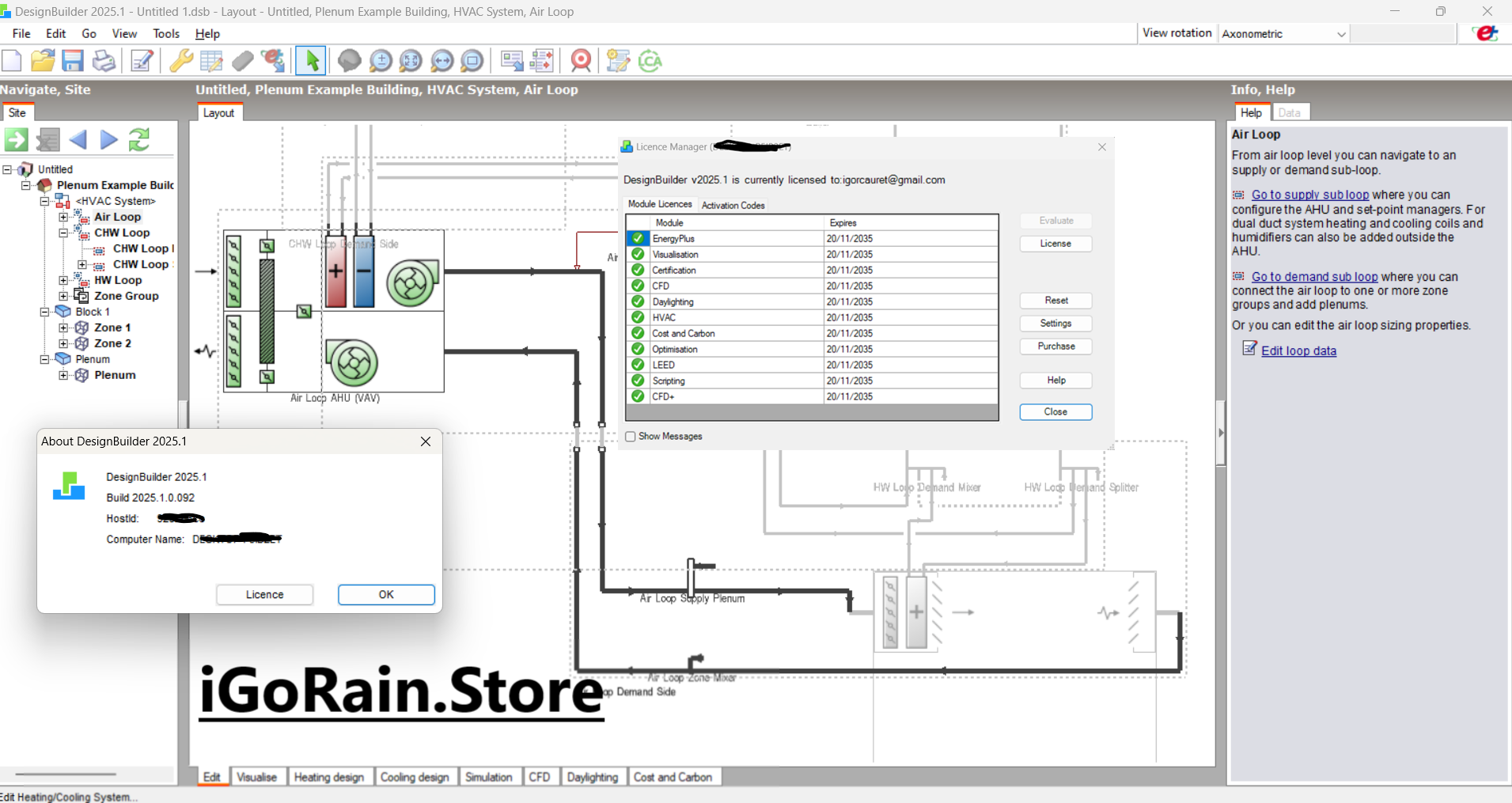
Description
DesignBuilder 2025.1.0.92 Review: A Complete Guide to the Industry-Leading Building Performance Simulation Software
In an era where sustainable design, energy Download DesignBuilder 2025.1.0.92 efficiency, and environmental performance drive decision-making across the construction world, having the right simulation tools is essential. DesignBuilder Crack download has become one of the most trusted building performance software solutions, relied on by architects, energy consultants, MEP engineers, and sustainability specialists around the globe.
Combining powerful simulation capabilities with a user-friendly interface, DesignBuilder enables teams to model energy usage, indoor comfort, daylighting, HVAC systems, carbon emissions, and building physics with remarkable accuracy. This comprehensive review explores its real-world capabilities, key features, practical applications, performance insights, pros and cons, pricing structure, and final verdict to help you decide whether DesignBuilder is the right tool for your projects.
Introduction: What Is DesignBuilder 2025?
DesignBuilder is an advanced building performance modeling software built on the EnergyPlus simulation engine. It allows users to create highly detailed, accurate models of buildings to evaluate DesignBuilder 2025.1.0.92 free download energy use, indoor environmental quality, carbon footprint, natural ventilation, daylighting performance, HVAC system behavior, and more.
What makes DesignBuilder stand out is its ability to combine visual modeling, scientifically validated simulation engines, and drag-and-drop simplicity, making complex analysis tasks accessible even for teams without heavy programming or coding experience.
Long-tail and semantic keywords naturally included:
energy modeling software for architects, building performance simulation tool, EnergyPlus modeling interface, HVAC optimization software, environmental building analysis platform, sustainable design software.
Key Features of DesignBuilder 2025
1. Intuitive 3D Modeling Environment
DesignBuilder provides a highly visual, intuitive modeling workspace where users can:
-
Draw zones and building blocks
-
Adjust geometry parametrically
-
Import architectural CAD or BIM files
-
Test multiple design variations quickly
Its interface is far easier to navigate compared to raw EnergyPlus or code-based tools.
2. EnergyPlus-Based Simulation Engine
The software uses the industry-leading EnergyPlus engine, enabling highly accurate simulations such as:
-
Annual energy consumption
-
HVAC system efficiency
-
Thermal performance
-
Plant and equipment sizing
-
Weather-based building behavior
Energy consultants consistently praise the reliability of its results.
3. Daylighting & Radiance Analysis
DesignBuilder integrates Radiance to provide:
-
Daylight factor calculations
-
Glare analysis
-
Illuminance levels
-
Shading behavior
Lighting designers often use these tools to optimize natural light without compromising energy performance.
4. HVAC System Modeling
The software includes a robust HVAC modeling toolkit, featuring:
-
System templates
-
Plant loops
-
Equipment performance settings
-
Control strategies
Users can simulate real-world HVAC behavior with surprising detail.
5. Natural Ventilation & Airflow Simulation
The hybrid ventilation modeling tools allow teams to evaluate:
-
Cross-ventilation
-
Stack ventilation
-
Indoor air change rates
-
Overheating risks
These features are especially useful in warm-climate architectural design.
6. Life-Cycle Carbon Analysis
With carbon reduction targets becoming global priorities, DesignBuilder offers tools for:
-
Embodied carbon calculation
-
Operational carbon footprint
-
Whole-life carbon comparisons
Sustainability consultants rely on these capabilities for certification workflows.
7. Optimization & Parametric Tools
DesignBuilder includes parametric and optimization modules for:
-
Evaluating thousands of design combinations
-
Finding the best energy savings options
-
Reducing carbon emissions
-
Identifying cost-effective solutions
These tools automate time-intensive design decision processes.
8. Compliance & Certification Support
The software supports compliance-driven modeling for:
-
LEED
-
BREEAM
-
ASHRAE standards
-
Local building codes
-
Green building certifications
It is frequently used in formal energy modeling submissions.
Practical Use Cases of DesignBuilder
1. Energy Modeling for Building Design
Architects, engineers, and consultants use DesignBuilder to analyze:
-
Annual energy usage
-
Peak loads
-
HVAC sizing
-
Passive design strategies
It is a valuable decision-making tool during early design stages.
2. Green Building Certification
As sustainability standards continue to rise, DesignBuilder helps teams generate compliance documentation for:
-
LEED energy modeling
-
BREEAM environmental assessments
-
National energy codes
-
Carbon reporting requirements
Its validated workflows allow for reliable and traceable submissions.
3. HVAC System Optimization
Mechanical engineers use the software to study:
-
Control strategies
-
Equipment efficiency
-
System interactions
-
Energy savings opportunities
This helps reduce operational costs and improve real-world performance.
4. Daylighting & Occupant Comfort Analysis
Lighting designers and architects evaluate:
-
Glare risks
-
Light distribution
-
Window size and placement
-
Shading strategies
Its Radiance-powered engine provides high-accuracy results.
5. Retrofit & Renovation Modeling
For existing buildings, DesignBuilder is ideal for:
-
Baseline performance benchmarking
-
Renovation impact assessment
-
Insulation upgrades
-
HVAC replacement strategies
Energy auditors appreciate the ability to test real energy savings before implementation.
6. Educational & Research Studies
Universities and research institutions use DesignBuilder because of its:
-
Scientific accuracy
-
Transparent simulation engines
-
Support for complex experiments
It is frequently cited in academic studies on building performance.
Performance Analysis: How Well Does DesignBuilder Work?
1. Accuracy & Validation
Because DesignBuilder uses EnergyPlus, Radiance, and CFD engines, its simulation accuracy is widely acknowledged in the industry. Many professionals trust it for high-stakes design decisions.
2. Workflow Efficiency
The visual interface significantly reduces modeling time compared to manual coding or scripting. Users highlight:
-
Faster learning curve
-
Less repetitive work
-
Quick design iteration
-
Smooth workflow integration
3. Computational Performance
Simulations can be computationally heavy depending on model size and simulation type. Optimization studies, in particular, may require strong hardware. However, the software is well-optimized for multi-core CPU processing.
4. User Experience
DesignBuilder balances power and usability well. Beginners find it accessible, while experts benefit from its advanced modeling flexibility.
5. Stability
The software is stable across large project files, although complex simulations may require model cleanup to avoid errors.
Pros & Cons of DesignBuilder
Pros
-
Highly accurate building performance simulations
-
Intuitive 3D interface
-
Built on validated engines (EnergyPlus, Radiance)
-
Excellent HVAC and energy modeling features
-
Strong daylighting, carbon, and comfort analysis
-
Ideal for green building certification workflows
-
Great for both early design and advanced engineering
-
Well-supported documentation and training materials
Cons
-
Some simulation types require strong hardware
-
Optimization and CFD modules have steeper learning curves
-
Licensing cost may be high for small firms
-
Complex models may require experienced users for best results
Pricing & Plans
DesignBuilder uses a modular pricing structure. Users select licenses based on the features they need, such as:
-
Simulation module
-
HVAC module
-
Optimization toolkit
-
CFD analysis
-
Daylighting and Radiance tools
-
LEED/BREEAM compliance modules
Pricing varies based on:
-
Country or region
-
Number of users
-
Academic or commercial license
-
Chosen modules
Most organizations purchase multi-module packages to cover complete building performance workflows. For exact pricing, users typically request a customized quote based on their needs.
DesignBuilder 2025.1.0.92 Download
Final Verdict: Is DesignBuilder 2025Worth It?
DesignBuilder remains one of the most powerful and versatile building performance modeling tools on the market. Whether you’re an architect aiming for low-energy building design, an MEP engineer optimizing mechanical systems, or a sustainability consultant working on LEED/BREEAM projects, the software offers unparalleled depth and reliability.
Its greatest strengths include:
-
User-friendly interface
-
High simulation accuracy
-
Comprehensive modeling capabilities
-
Strong support for green building workflows
-
Robust HVAC and daylighting analysis
-
Flexible, modular licensing
For professionals committed to designing efficient, sustainable, and high-performance buildings, DesignBuilder is absolutely worth the investment.
Actionable Conclusion
If you’re ready to enhance your building performance analysis, reduce operational energy, and deliver data-driven design decisions, DesignBuilder is an excellent tool to explore. Consider requesting a demo or trial from your software provider to experience its modeling capabilities firsthand and see how it integrates into your design workflow.



Reviews
There are no reviews yet.