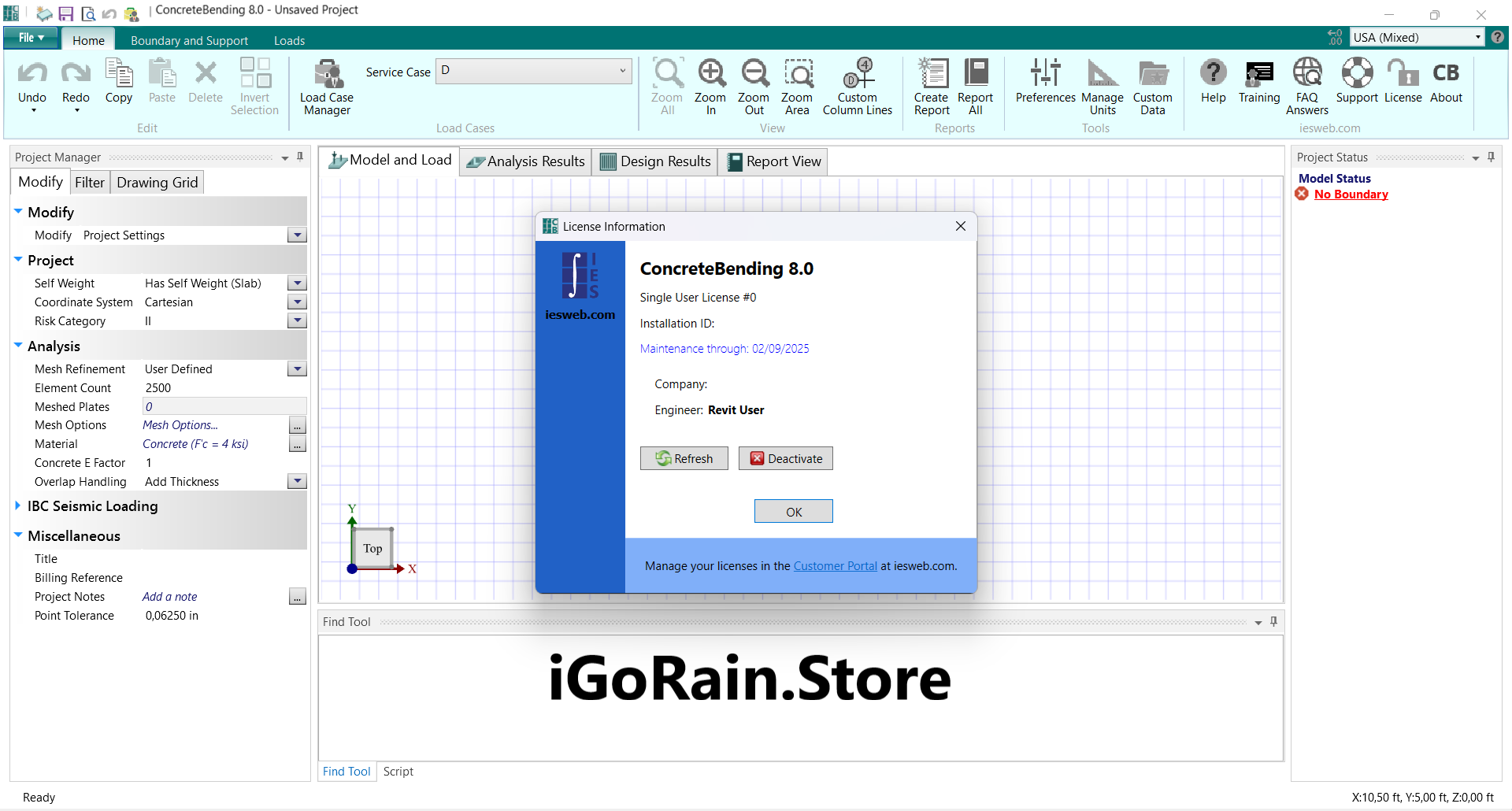
Description
ConcreteBending: Precision Software for Reinforced Concrete Design and Bending Analysis
Summary
ConcreteBending is a specialized engineering software developed to support accurate analysis and design of reinforced concrete elements subjected to bending forces. Built for structural engineers, civil consultants, and design professionals, the software focuses on simplifying complex bending calculations while ensuring compliance with engineering principles and design standards.
In reinforced concrete design, bending behavior governs the safety and performance of beams, slabs, and structural members. Manual calculations are time-consuming and prone to error, especially in projects with multiple load combinations and design iterations. ConcreteBending addresses this challenge by providing a reliable, calculation-driven environment where engineers can evaluate bending moments, reinforcement requirements, and section performance with confidence.
This in-depth review examines Concrete Bending from a professional perspective, covering its features, practical applications, performance, strengths, limitations, and overall value for structural design workflows.
Introduction
Reinforced concrete structures are fundamental to modern construction. From residential buildings to large-scale infrastructure, concrete elements must be carefully designed to resist bending stresses caused by loads, spans, and usage conditions. Even small miscalculations can compromise structural safety or lead to inefficient designs.
Concrete Bending was created to help engineers navigate these challenges with greater accuracy and efficiency. Instead of relying solely on spreadsheets or manual formulas, the software provides a structured approach to bending analysis that reflects real-world engineering scenarios.
By focusing specifically on concrete bending behavior, the software offers depth and precision rather than generic structural analysis. For professionals who design beams, slabs, and reinforced sections regularly, Concrete Bending serves as a focused and dependable design companion.
Key Features of ConcreteBending
Concrete Bending is built around engineering accuracy, usability, and workflow efficiency.
Reinforced Concrete Bending Analysis
At its core, Concrete Bending performs detailed bending analysis for reinforced concrete sections. Engineers can evaluate internal forces, bending moments, and stress distribution with clarity.
This allows for informed design decisions and reduces uncertainty during critical design stages.
Reinforcement Calculation and Optimization
Concrete Bending assists in calculating required reinforcement based on bending demands. The software helps engineers determine appropriate reinforcement areas and arrangements while maintaining structural safety.
This leads to optimized designs that balance strength, material usage, and constructability.
Section Property Definition
Users can define concrete section properties accurately, including geometry, material characteristics, and reinforcement details. This flexibility allows Concrete Bending to adapt to a wide range of structural scenarios.
Clear section modeling improves confidence in analysis results.
Load and Moment Handling
ConcreteBending supports the evaluation of bending moments resulting from applied loads. Engineers can analyze how sections behave under different loading conditions and identify governing design cases.
This is especially useful during design iterations and value engineering exercises.
Clear Calculation Outputs
The software presents calculation results in an organized and interpretable format. Engineers can easily review bending capacity, reinforcement requirements, and safety margins without sorting through complex spreadsheets.
Clear outputs improve transparency and support engineering review processes.
Practical Use Cases
ConcreteBending is applicable across many real-world structural engineering scenarios.
Beam Design in Buildings
Structural engineers designing reinforced concrete beams can use ConcreteBending to evaluate bending moments and determine reinforcement requirements efficiently. The software helps ensure beams meet strength criteria while avoiding overdesign.
This is particularly useful in residential and commercial building projects with repetitive beam layouts.
Slab Design Support
For slab elements subject to bending, ConcreteBending provides insight into section performance under applied loads. Engineers can assess bending behavior and adjust reinforcement accordingly.
This improves slab efficiency and structural reliability.
Structural Consulting and Design Offices
Consulting engineers benefit from ConcreteBending’s focused functionality during feasibility studies and detailed design. Quick analysis supports faster decision-making and improves project turnaround time.
The software fits well into professional design office workflows.
Academic and Training Use
ConcreteBending can also be used as a learning tool for understanding reinforced concrete bending behavior. Engineering students and junior engineers gain practical exposure to bending analysis without oversimplified assumptions.
This supports deeper understanding of structural behavior.
Performance Analysis
ConcreteBending is designed to deliver consistent and reliable results in professional environments.
Calculation Accuracy
The software provides dependable bending calculations based on established structural engineering principles. By reducing manual computation, ConcreteBending minimizes the risk of arithmetic errors.
Accurate results build trust in design outputs.
Speed and Efficiency
ConcreteBending allows engineers to evaluate bending scenarios quickly, making it suitable for projects with tight deadlines. Design iterations can be performed efficiently without rebuilding calculations from scratch.
This improves productivity in fast-paced design environments.
Stability and Reliability
In regular use, ConcreteBending performs reliably without unexpected interruptions. Engineers can depend on consistent behavior when analyzing multiple design cases.
Stable performance is essential for professional workflows.
Learning Curve
ConcreteBending maintains a relatively low learning curve for engineers familiar with reinforced concrete design. Its focused scope and logical workflow help users become productive quickly.
Minimal training is required for effective use.
Pros and Cons
Pros
-
Focused on reinforced concrete bending analysis
-
Improves accuracy compared to manual calculations
-
Saves time during design iterations
-
Clear and organized calculation outputs
-
Suitable for professional and academic use
Cons
-
Limited to bending-focused analysis
-
Requires understanding of structural design principles
-
Not intended as a full structural analysis suite
Pricing and Plans
Pricing for ConcreteBending typically depends on licensing options such as individual or institutional use. While exact pricing may vary, the software is generally positioned as a professional engineering tool rather than a basic calculator.
For engineers and firms involved in reinforced concrete design, the value comes from time savings, reduced errors, and improved design confidence.
Google EEAT Evaluation: Why ConcreteBending Is Trustworthy
Experience
ConcreteBending reflects real-world structural engineering challenges related to bending behavior in reinforced concrete. Its functionality aligns with daily design tasks faced by professionals.
Expertise
The software demonstrates strong technical understanding of concrete bending mechanics and reinforcement design principles.
Authority
By focusing on a specific and critical aspect of structural design, ConcreteBending establishes authority as a specialized engineering tool rather than a generic solution.
Trust
Consistent calculations, transparent outputs, and predictable behavior build trust among engineers who rely on accurate structural data.
Final Verdict
ConcreteBending is a practical and dependable software solution for engineers who regularly design reinforced concrete elements subject to bending. Its focused approach, accurate calculations, and clear outputs make it a valuable addition to structural design workflows.
While it does not replace comprehensive structural analysis software, ConcreteBending excels in its niche. For professionals who want reliable bending analysis without unnecessary complexity, it delivers exactly what is needed.




Reviews
There are no reviews yet.