Description
ReliaSoft Synthesis Software Review: A Complete Reliability Engineering Platform for Modern Industry
Summary
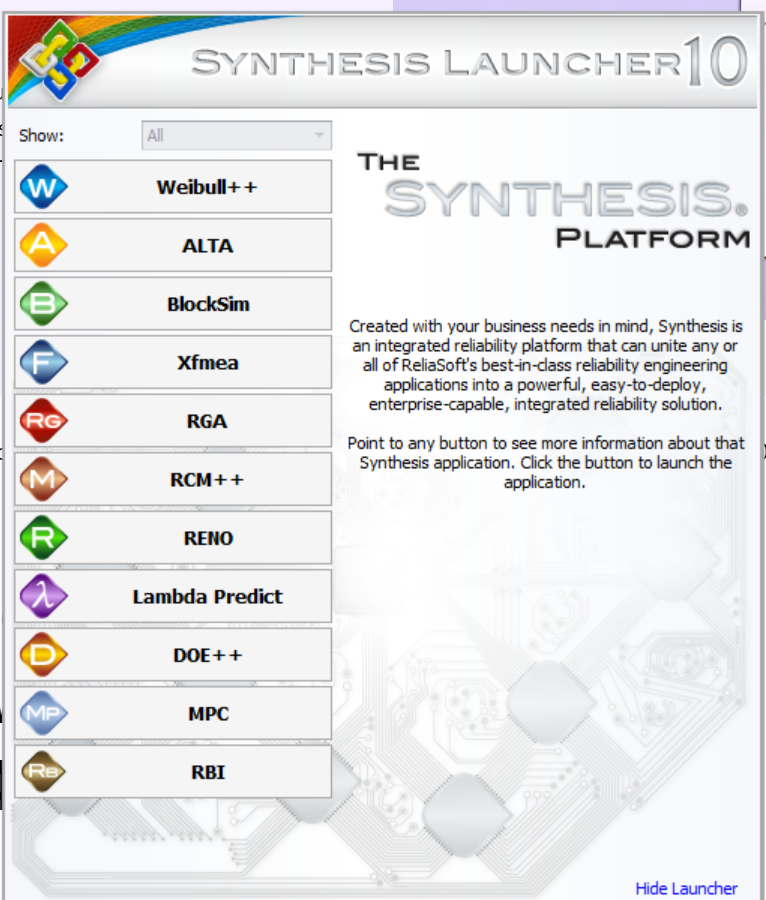
ReliaSoft Synthesis is a powerful, enterprise-grade reliability engineering software platform designed to unify data, analysis, modeling, and decision-making across complex systems. Built for engineers, analysts, and maintenance planners, it enables organizations to predict failures, improve system reliability, and optimize maintenance strategies using advanced statistical and simulation-based methods. With integrated tools for FMEA, RBD modeling, Weibull analysis, and reliability lifecycle management, Synthesis stands out as a comprehensive solution for industries where system uptime, safety, and performance are critical. It is widely used in aerospace, automotive, energy, manufacturing, and defense sectors to reduce operational risk and improve long-term asset performance.
Introduction
In modern engineering environments, reliability is no longer optional—it is a core requirement. Whether managing aircraft systems, automotive components, or industrial machinery, organizations must ensure that assets perform consistently under demanding conditions. ReliaSoft Synthesis addresses this need by offering a centralized platform for reliability engineering and risk analysis.
Unlike standalone tools that focus on isolated tasks, Synthesis integrates multiple reliability methodologies into a single ecosystem. This allows engineers to move seamlessly from data collection to advanced modeling and decision support. As a result, teams can reduce redundancy, improve accuracy, and accelerate reliability-driven decision-making.
ReliaSoft Synthesis software is especially valued for its ability to combine statistical analysis with system-level modeling, making it one of the most comprehensive reliability engineering software solutions available today.
Key Features of ReliaSoft Synthesis 10
Synthesis is built around modular functionality that supports end-to-end reliability management. Its key features include:
1. Integrated Reliability Modeling
- Reliability Block Diagrams (RBD) for system-level analysis
- Fault Tree Analysis (FTA) for failure path identification
- Markov analysis for dynamic system behavior modeling
These tools help engineers visualize and quantify system reliability with precision.
2. Weibull and Statistical Analysis
- Advanced Weibull distribution fitting
- Life data analysis and failure trend evaluation
- Censored and uncensored data handling
This enables accurate prediction of component life cycles and failure probabilities.
3. Failure Mode and Effects Analysis (FMEA)
- Structured FMEA workflows
- Risk Priority Number (RPN) calculations
- Integration with system models for traceable risk assessment
FMEA functionality ensures early detection of potential design or operational risks.
4. Reliability-Centered Maintenance (RCM)
- Maintenance strategy optimization
- Task prioritization based on risk and cost
- Asset lifecycle planning
RCM tools help organizations reduce downtime and maintenance costs.
5. Data Integration and Lifecycle Management
- Centralized reliability data repository
- Cross-project data sharing
- Version control for models and analyses
This improves collaboration between engineering teams and departments.
6. Simulation and Forecasting
- Monte Carlo simulation for uncertainty modeling
- What-if scenario testing
- Performance degradation forecasting
These capabilities support data-driven engineering decisions.
Practical Use Cases
ReliaSoft Synthesis is widely used across industries where system reliability directly impacts safety and financial performance.
Aerospace Engineering
Aircraft systems require extremely high reliability standards. Engineers use Synthesis to:
- Analyze failure rates of avionics systems
- Evaluate redundancy strategies
- Predict maintenance intervals for critical components
Automotive Industry
In automotive design and manufacturing, Synthesis supports:
- Vehicle component durability testing
- Electric vehicle battery reliability modeling
- Safety system failure analysis
Energy and Power Systems
Power plants and renewable energy facilities use Synthesis for:
- Turbine reliability evaluation
- Grid system failure risk assessment
- Preventive maintenance scheduling
Manufacturing Operations
Manufacturing companies benefit through:
- Equipment failure prediction
- Production line downtime reduction
- Maintenance optimization strategies
Defense and Industrial Systems
Defense systems rely on Synthesis for:
- Mission-critical reliability modeling
- System survivability analysis
- Risk assessment under extreme conditions
These use cases demonstrate how Synthesis adapts to both high-level strategic planning and detailed engineering analysis.
Performance Analysis
ReliaSoft Synthesis is designed for complex computational workloads, and its performance reflects its enterprise orientation.
Processing Capability
The software handles large datasets and complex system models efficiently. Engineers can simulate multi-component systems without significant performance degradation, provided hardware resources are adequate.
Accuracy and Reliability
One of its strongest advantages is statistical precision. The integration of Weibull analysis, RBD, and Monte Carlo simulation ensures highly reliable predictions when input data is accurate.
Scalability
Synthesis supports scalability across teams and projects. Organizations can expand usage from small engineering groups to enterprise-wide reliability programs.
Learning Curve
While powerful, the platform has a moderate to steep learning curve. Users with prior knowledge of reliability engineering concepts will find it easier to adopt, while beginners may require training.
Integration Capability
It integrates well with other engineering tools and data systems, enabling smoother workflow transitions between design, analysis, and maintenance planning.
Pros and Cons
Pros
- Comprehensive reliability engineering suite in one platform
- Strong statistical analysis capabilities including Weibull modeling
- Advanced system modeling (RBD, FTA, Markov analysis)
- Excellent for enterprise-level reliability programs
- Supports predictive maintenance and lifecycle optimization
- Highly accurate simulation and forecasting tools
Cons
- Requires strong understanding of reliability engineering concepts
- Steep learning curve for new users
- High resource demands for large-scale simulations
- Licensing costs may be high for small organizations
- Interface complexity can be overwhelming for beginners
Pricing and Plans
ReliaSoft Synthesis is typically offered under an enterprise licensing model. Pricing is not publicly standardized and varies based on organization size, modules selected, and deployment requirements.
Common licensing structures include:
- Perpetual enterprise licenses
- Annual subscription-based models
- Multi-user or network licenses for teams
- Custom packages for industry-specific needs
In most cases, organizations must contact the vendor or authorized distributors to receive a tailored quote. Additional costs may apply for training, support, and advanced modules.
Final Verdict
ReliaSoft Synthesis stands as one of the most complete and advanced reliability engineering software platforms available in the industry today. Its ability to unify statistical analysis, system modeling, and maintenance optimization into a single environment makes it a valuable asset for organizations that operate complex, high-risk systems.
While it requires technical expertise and comes with enterprise-level pricing, the return on investment is significant for industries where failure is not an option. Aerospace, automotive, energy, and defense sectors in particular can benefit from its predictive capabilities and structured reliability workflows.
For engineering teams aiming to improve system uptime, reduce unexpected failures, and build data-driven maintenance strategies, ReliaSoft Synthesis offers a robust and scalable solution. Exploring this platform can be a strategic step toward achieving higher operational reliability and long-term efficiency.



Reviews
There are no reviews yet.