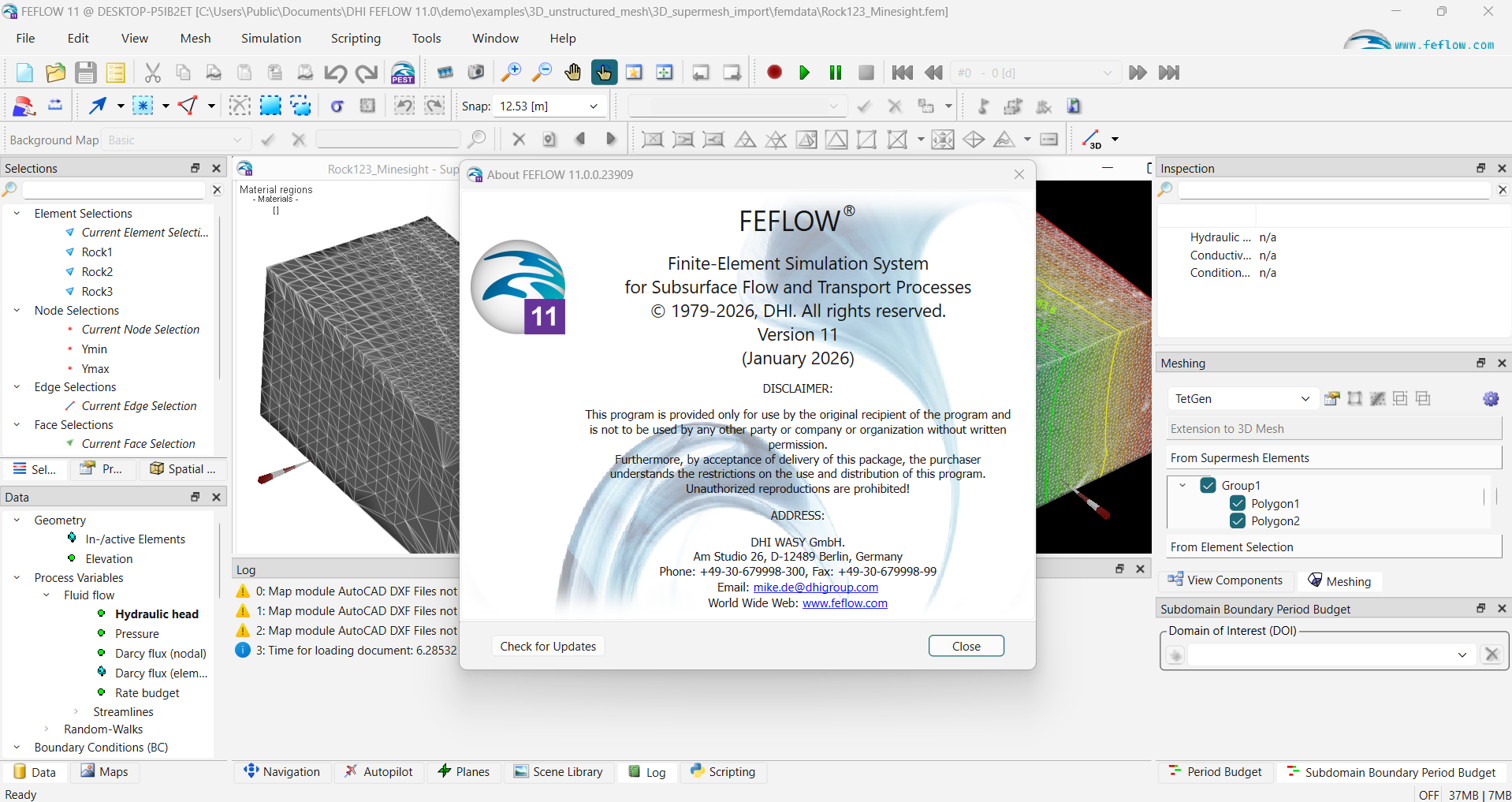
Description
DHI FEFLOW 11.0: Advanced Groundwater Modeling Software for Complex Subsurface Challenges
When groundwater systems become too complex for simple calculations, DHI FEFLOW provides the advanced modeling capabilities needed to understand what is happening beneath the surface. As a powerful finite element groundwater modeling platform, FEFLOW is designed for professionals working with groundwater flow, heat transport, mass transport, and subsurface processes. Its flexibility makes it suitable for everything from environmental investigations and mine water management to geothermal energy projects and large-scale water resource planning.
What makes DHI FEFLOW particularly valuable is its ability to model real-world groundwater conditions in three dimensions while handling complex geological formations, variable boundary conditions, and coupled transport processes. For engineers, hydrogeologists, environmental consultants, researchers, and water resource specialists, the software offers a detailed environment for creating, analyzing, and communicating sophisticated groundwater models.
If you need professional groundwater simulation software capable of handling challenging subsurface scenarios, DHI FEFLOW is one of the most comprehensive solutions available today.
Introduction
Groundwater modeling is rarely simple in the real world. Aquifers can have irregular boundaries, multiple geological layers, changing recharge rates, pumping wells, contaminant plumes, and complex interactions with rivers, lakes, and other surface water systems.
A basic model may work for a straightforward site investigation, but large engineering and environmental projects often require much more. This is where DHI FEFLOW groundwater modeling software becomes especially useful.
FEFLOW, which stands for Finite Element subsurface FLOW and transport simulation system, is built around the finite element method. This approach allows users to represent complicated geometries and geological conditions with considerable flexibility. Instead of forcing every project into a simple grid, users can develop detailed meshes that better reflect the shape and behavior of real subsurface systems.
The result is a professional modeling environment that supports:
- Three-dimensional groundwater flow simulation
- Mass transport modeling
- Heat transport analysis
- Density-dependent flow
- Variable-density groundwater processes
- Geothermal modeling
- Coupled groundwater and surface water studies
- Advanced data visualization and model analysis
For professionals who regularly work with groundwater simulation, FEFLOW is more than a basic calculation tool. It is a complete modeling platform designed for detailed analysis and decision-making.
Key Features of DHI FEFLOW
Advanced Finite Element Modeling
The foundation of DHI FEFLOW is its finite element modeling technology. This allows users to create flexible meshes for complex geological structures and irregular project areas.
This flexibility can be particularly useful when modeling:
- Layered aquifer systems
- Fault zones
- Irregular geological formations
- Excavation sites
- Mining areas
- Coastal aquifers
- Geothermal reservoirs
Rather than relying only on simple rectangular grids, users can develop models that more closely represent the actual physical environment.
3D Groundwater Flow Simulation
Three-dimensional groundwater flow modeling is one of FEFLOW’s primary strengths. Users can simulate groundwater movement through complex subsurface environments and analyze how hydraulic conditions change over time.
A typical model may include:
- Recharge and infiltration
- Pumping wells
- Injection wells
- Drainage systems
- Rivers and lakes
- Impermeable boundaries
- Hydraulic barriers
- Complex aquifer interactions
This provides a more realistic view of how water moves through different geological formations.
Mass Transport and Contaminant Modeling
Environmental consultants and remediation specialists often need to understand not only where groundwater flows, but also how contaminants move through an aquifer.
DHI FEFLOW supports advanced mass transport simulations that can help analyze:
- Contaminant migration
- Chemical concentration changes
- Dispersion
- Advection
- Sorption processes
- Degradation and reaction processes
For example, a consultant investigating an industrial site could create a groundwater contaminant model to estimate how a pollutant may spread over time. This information can support remediation planning and risk assessment.
Heat Transport and Geothermal Analysis
FEFLOW is also widely suited to projects involving subsurface heat movement. This makes it useful for geothermal energy applications and thermal groundwater studies.
Users can model:
- Ground-source heat pump systems
- Geothermal wells
- Thermal energy storage
- Underground heat exchange
- Thermal plumes
- Temperature changes in aquifers
For renewable energy engineers, the ability to analyze groundwater flow and heat transport within the same modeling environment can provide valuable insight into system performance.
Density-Dependent Flow
Groundwater systems involving saltwater intrusion, saline aquifers, or fluids with different densities require specialized modeling capabilities.
FEFLOW can be used for density-dependent groundwater simulations, making it suitable for projects involving:
- Coastal aquifers
- Saltwater intrusion
- Brine movement
- Saline groundwater
- Variable-density subsurface flow
This capability is especially important in regions where freshwater resources are threatened by seawater intrusion or changing groundwater conditions.
Strong Visualization and Analysis Tools
A complex groundwater model is only useful if the results can be understood and communicated clearly.
FEFLOW provides tools for visualizing model results, allowing users to examine groundwater flow patterns, pressure distributions, concentration changes, temperature fields, and other important variables.
Professionals can use visual outputs to:
- Identify groundwater flow directions
- Analyze drawdown around pumping wells
- Track contaminant migration
- Examine thermal plumes
- Compare simulation scenarios
- Present results to project stakeholders
The visual aspect of the software can significantly improve the process of interpreting complex numerical results.
Practical Use Cases
Environmental Contamination Studies
One of the most common applications for groundwater modeling is environmental assessment.
Suppose an industrial facility has historically used chemicals that may have entered the soil and groundwater. A consultant can use FEFLOW to develop a model of the site, simulate groundwater movement, and estimate how contaminants could migrate.
This type of analysis may help answer questions such as:
- Where is the contaminant plume moving?
- How quickly could contamination reach a nearby water body?
- Which areas may be affected in the future?
- What remediation strategy could reduce the risk?
This gives environmental teams a more informed basis for decision-making.
Mining and Mine Water Management
Mining operations often significantly affect groundwater systems. Excavation, dewatering, underground workings, and changing geological conditions can all influence groundwater flow.
DHI FEFLOW can help engineers investigate:
- Mine dewatering requirements
- Groundwater inflow
- Aquifer drawdown
- Water table changes
- Re-infiltration strategies
- Potential impacts on nearby water resources
A detailed model can help mining companies better understand water-related risks before implementing major operational changes.
Geothermal Energy Projects
As interest in renewable energy grows, geothermal modeling has become increasingly important.
FEFLOW can be used to simulate how groundwater and heat interact within the subsurface. Engineers may use the software to study thermal storage systems, geothermal wells, and heat exchange performance.
For example, a project team designing a geothermal system could evaluate how repeated heating and cooling cycles affect the surrounding aquifer over several years.
Water Resource Planning
Groundwater is a critical resource for agriculture, municipalities, and industry. Over-pumping can lead to declining water levels and long-term resource problems.
Using FEFLOW, water resource specialists can simulate different scenarios and evaluate:
- Sustainable pumping rates
- Long-term groundwater decline
- Artificial recharge
- Interaction between surface water and groundwater
- Effects of drought conditions
This makes the software useful for strategic groundwater management.
Coastal Groundwater Studies
Coastal aquifers face the constant risk of saltwater intrusion. Excessive pumping can disturb the balance between freshwater and seawater.
A density-dependent model can help researchers and engineers investigate how pumping patterns may influence saltwater movement and identify strategies for protecting freshwater resources.
Performance Analysis
In practical use, DHI FEFLOW is best suited to users who need depth and flexibility rather than a simplified modeling experience.
The software performs particularly well when a project involves multiple physical processes. Instead of using separate tools for groundwater flow, contaminant transport, and heat movement, users can work within a unified modeling environment.
Its key performance advantages include:
- Flexible representation of complex geometries
- Support for detailed three-dimensional modeling
- Strong handling of coupled groundwater processes
- Advanced simulation capabilities
- Detailed visualization of model results
- Suitability for large and technically demanding projects
However, the software’s advanced capabilities also mean that users need a solid understanding of hydrogeology and numerical modeling. Someone completely new to groundwater simulation may find the learning curve demanding.
In real-world professional workflows, the quality of results depends not only on the software but also on the quality of the input data, conceptual model, mesh design, boundary conditions, calibration, and interpretation.
A powerful model cannot compensate for poor assumptions. Experienced users understand that FEFLOW is most effective when combined with reliable field data and a carefully developed conceptual understanding of the groundwater system.
User Experience and Learning Curve
For experienced hydrogeologists and engineers, FEFLOW offers a powerful and highly configurable environment. The software provides the depth needed for professional modeling, but beginners should expect to spend time learning the workflow.
New users may initially need to understand:
- Finite element concepts
- Mesh generation
- Boundary conditions
- Initial conditions
- Calibration
- Time stepping
- Transport parameters
- Model validation
Once these concepts become familiar, the software becomes much more practical to use.
The typical professional workflow may involve:
- Collecting and preparing geological and hydrogeological data.
- Building the model geometry.
- Creating and refining the finite element mesh.
- Defining material properties and boundary conditions.
- Running simulations.
- Calibrating the model against observed data.
- Reviewing results and testing scenarios.
- Communicating findings through visual outputs and reports.
This structured approach makes FEFLOW suitable for serious engineering and scientific work.
Pros and Cons
Pros
- Powerful three-dimensional groundwater modeling capabilities
- Flexible finite element approach for complex geometries
- Supports groundwater flow, heat, and mass transport
- Suitable for environmental, mining, geothermal, and water resource projects
- Strong visualization and result interpretation tools
- Capable of handling complex and coupled subsurface processes
- Professional-grade modeling environment
Cons
- Requires technical knowledge of hydrogeology and numerical modeling
- Learning curve can be significant for beginners
- Advanced projects may require substantial data preparation
- Complex models can require considerable computational resources
- Professional software licensing may not suit casual or occasional users
Pricing and Plans
The cost of DHI FEFLOW can depend on factors such as the licensing arrangement, edition, organization type, and commercial or academic usage.
Because professional engineering software pricing can change and may vary by customer requirements, prospective users should verify the current licensing options directly through the appropriate official sales channel before making a purchase decision.
For organizations that depend on groundwater modeling for engineering, environmental consulting, research, or infrastructure planning, the value of FEFLOW is often measured by the quality of analysis and decision support it provides rather than simply by the software license cost.
Who Should Use DHI FEFLOW?
DHI FEFLOW is a strong choice for:
- Hydrogeologists
- Environmental consultants
- Civil and environmental engineers
- Mining engineers
- Geothermal specialists
- Water resource managers
- Research institutions
- Universities
- Government agencies
- Engineering consulting companies
It may be excessive for users who only need simple groundwater calculations. However, when the project involves complex geological structures, multiple transport processes, or long-term scenario analysis, the additional capabilities can be highly valuable.
Final Verdict
DHI FEFLOW is a powerful groundwater modeling solution designed for professionals who need detailed, flexible, and technically advanced subsurface simulations. Its finite element approach provides the flexibility required for complex geological environments, while its support for groundwater flow, mass transport, heat transport, and density-dependent processes makes it suitable for a wide range of demanding applications.
The software is particularly valuable in environmental contamination studies, mining, geothermal energy, groundwater resource management, and coastal aquifer analysis.
Its biggest strength is also its main challenge: FEFLOW is highly capable because it is technically sophisticated. Beginners may need time to learn the modeling concepts and workflows, but professionals who invest in understanding the platform can gain access to a powerful environment for analyzing difficult groundwater problems.
For anyone searching for advanced groundwater modeling software capable of handling realistic three-dimensional subsurface conditions, DHI FEFLOW deserves serious consideration. If your work involves complex aquifer systems, contaminant transport, geothermal modeling, or groundwater management, exploring the capabilities of FEFLOW can be a practical step toward creating more reliable and informed engineering decisions.



Reviews
There are no reviews yet.