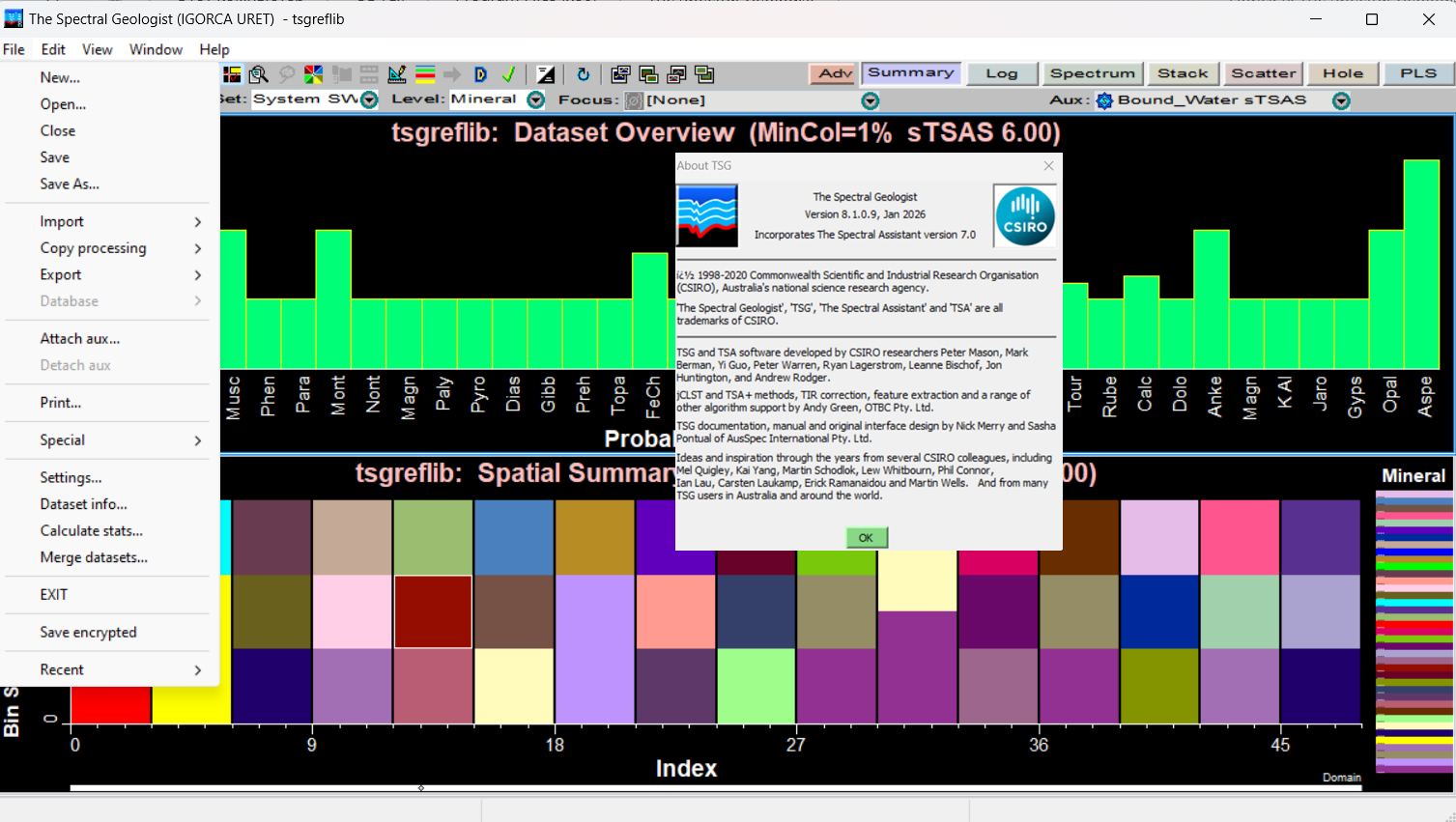
Description
The Spectral Geologist 2o26: Advanced Spectral Analysis Software for Modern Geological Exploration
When geological data becomes too complex for traditional interpretation methods, The Spectral Geologist offers a focused solution for professionals who need to analyze, compare, and interpret spectral information with greater confidence. Designed for geological and mineral exploration workflows, the software helps transform raw spectral measurements into meaningful information about minerals, rocks, alteration zones, and geological environments.
For geologists working with hyperspectral data, field spectrometers, core samples, remote sensing datasets, or mineral identification projects, having the right analytical software can make a significant difference. The Spectral Geologist provides a specialized environment for examining spectral signatures, managing spectral libraries, comparing samples, and supporting geological interpretation.
In practical use, the software is particularly valuable when a geologist needs to move beyond simple visual inspection. Instead of manually comparing complex spectral curves, users can organize datasets, investigate wavelength responses, identify potential mineral matches, and improve the consistency of their interpretations. This makes The Spectral Geologist an interesting option for mineral exploration companies, geological consultants, academic researchers, and professionals working with spectral geology.
Introduction
Modern geology increasingly depends on digital data. Field observations, laboratory measurements, satellite imagery, airborne sensors, and hyperspectral instruments can generate enormous amounts of information. The challenge is not simply collecting data; it is interpreting that data accurately and efficiently.
Spectral analysis is an important part of this process. Different minerals and geological materials interact with electromagnetic energy in distinctive ways. Their spectral responses can reveal information that may not be immediately visible in the field or through conventional geological mapping.
This is where The Spectral Geologist software becomes useful.
The program is designed around the needs of geological spectral analysis. Rather than functioning as a general-purpose scientific application, it focuses on the specialized requirements of mineral and geological interpretation. Users can work with spectral data, examine absorption features, compare measurements, and use reference information to support geological conclusions.
For someone analyzing a mineralized zone, for example, spectral information can help identify alteration minerals associated with hydrothermal systems. In exploration, this may provide an additional layer of evidence when evaluating potential targets.
What Is The Spectral Geologist?
The Spectral Geologist is specialized geological software used for spectral data analysis and mineral identification. Its primary purpose is to help users interpret the spectral characteristics of geological materials and connect those characteristics with mineralogical and geological information.
The software can be useful across several stages of a geological project:
- Field data collection and interpretation
- Mineral exploration
- Hyperspectral analysis
- Core and rock sample examination
- Spectral library management
- Academic geological research
- Geological mapping and alteration studies
The main advantage of a dedicated solution is specialization. A general spreadsheet or basic graphing program may display spectral curves, but it usually does not provide the same geological context or analytical workflow.
The Spectral Geologist is intended to help users work with spectral information in a way that supports real geological decision-making.
Key Features of The Spectral Geologist
Spectral Data Analysis
At the heart of the software is the ability to work with spectral datasets. Users can examine spectral curves and investigate the behavior of geological materials across different wavelengths.
This is important because spectral signatures often contain subtle features. A small absorption band may provide valuable clues about the presence of a specific mineral or alteration assemblage.
A dedicated spectral analysis workflow can help users:
- Inspect spectral reflectance behavior
- Compare multiple spectral signatures
- Examine absorption features
- Investigate mineral-related spectral characteristics
- Identify patterns within geological datasets
For professionals handling large amounts of spectral information, organized analysis can be much more efficient than manually examining individual files.
Mineral Identification Support
One of the most practical applications of The Spectral Geologist is supporting mineral identification.
When a measured sample produces a particular spectral response, users can compare it with known reference spectra. This can help determine which minerals may be present or which mineral groups deserve further investigation.
The software should not be treated as a replacement for laboratory confirmation or expert geological judgment. Instead, it functions as a powerful interpretation tool that can help narrow down possibilities and guide further analysis.
Spectral Library Management
Spectral libraries are essential in mineral spectroscopy. They provide reference data that can be compared against unknown samples.
A well-organized spectral library can help geologists:
- Store reference spectra
- Compare known and unknown materials
- Build project-specific collections
- Reuse historical data
- Improve consistency across multiple projects
For organizations working on long-term exploration programs, the ability to maintain and reuse spectral information can become particularly valuable.
Geological Interpretation
Spectral data is most useful when it can be connected to geological meaning. The Spectral Geologist is designed to support this connection by helping users interpret spectral responses in the context of mineralogy and geological processes.
This is especially relevant for:
- Hydrothermal alteration mapping
- Mineral exploration
- Lithological interpretation
- Remote sensing analysis
- Geological research
Instead of treating spectral curves as isolated technical graphs, users can use the information as part of a broader geological interpretation workflow.
Practical Use Cases
Mineral Exploration
Mineral exploration is one of the clearest applications for The Spectral Geologist.
Imagine an exploration team investigating a large area with multiple alteration zones. Field teams collect spectral measurements from outcrops, drill cores, and soil or rock samples. The resulting dataset can become difficult to manage manually.
The Spectral Geologist can help organize and interpret this information, allowing geologists to compare samples and identify spectral patterns associated with specific minerals or alteration environments.
This may help exploration teams prioritize targets for additional fieldwork, geochemical testing, or drilling.
Hyperspectral Geological Analysis
Hyperspectral datasets can contain detailed information across a wide range of wavelengths. However, the volume and complexity of this information can make interpretation challenging.
The Spectral Geologist can support workflows where users need to examine spectral responses and relate them to mineral composition.
For researchers and professionals working with hyperspectral imagery, this type of software can serve as an important part of the interpretation process.
Core and Rock Sample Analysis
Spectral analysis is increasingly used alongside traditional core logging and laboratory testing.
A geologist examining a drill core may use spectral data to identify changes in mineralogy along the core interval. These changes can provide clues about alteration, lithology, or geological processes.
Using spectral analysis alongside conventional geological observations can create a more complete picture of subsurface conditions.
Academic and Research Projects
Universities and geological research organizations can also benefit from specialized spectral analysis software.
Students and researchers may use The Spectral Geologist for:
- Mineral spectroscopy studies
- Geological mapping research
- Remote sensing projects
- Spectral library development
- Comparative mineral analysis
The software can be particularly useful in research environments where users need to investigate spectral behavior in detail rather than simply produce basic charts.
Performance Analysis
The overall value of The Spectral Geologist depends heavily on the quality of the input data and the user’s geological expertise. Spectral analysis software can provide excellent results, but interpretation is only as reliable as the measurements, reference data, and analytical assumptions behind it.
From a workflow perspective, specialized software offers several advantages.
Efficient Data Interpretation
A dedicated geological application can reduce the time spent switching between unrelated tools. Users can focus on spectral analysis and geological interpretation within a more specialized environment.
Better Comparison Workflows
Comparing unknown samples with reference spectra is a common requirement in mineral spectroscopy. A structured comparison process can help users work more consistently.
Useful for Complex Datasets
The software is particularly valuable when projects involve numerous samples, spectral curves, or reference materials. Managing these datasets manually can quickly become inefficient.
Supports Expert Decision-Making
The Spectral Geologist does not eliminate the need for professional interpretation. Instead, it gives geologists better information with which to make decisions.
This distinction is important. The software is best viewed as an analytical assistant for experienced users rather than an automatic replacement for geological expertise.
User Experience and Learning Curve
For a professional geologist already familiar with spectroscopy, the learning curve is likely to be more manageable because the software’s purpose is directly related to geological workflows.
New users may need time to understand:
- Spectral terminology
- Wavelength behavior
- Reference library concepts
- Mineral absorption features
- Data interpretation methods
The best results generally come when users combine software training with practical geological knowledge.
A typical workflow might involve:
- Importing or accessing spectral data.
- Reviewing sample information.
- Examining spectral curves.
- Comparing results with reference materials.
- Investigating potential mineral matches.
- Combining spectral evidence with geological observations.
- Exporting or documenting conclusions for project reporting.
This process can make spectral interpretation more structured and repeatable.
Pros and Cons
Pros
- Specialized for geological spectral analysis
- Useful for mineral identification workflows
- Supports spectral data comparison
- Can assist mineral exploration projects
- Valuable for hyperspectral and spectroscopy research
- Helps connect spectral measurements with geological interpretation
- Suitable for professional, academic, and research environments
- Can improve organization of reference spectral information
Cons
- May require prior knowledge of geology and spectroscopy
- Advanced users may need time to learn the complete workflow
- Results depend heavily on input data quality
- Spectral interpretation still requires expert judgment
- Specialized software may be more than casual users need
Pricing and Plans
The availability and cost of The Spectral Geologist may depend on the licensing model, edition, distributor, or current commercial arrangements. Specialized scientific and geological applications can use different licensing structures, including standalone licenses, institutional access, educational arrangements, or professional packages.
Before purchasing, potential users should evaluate:
- Supported operating systems
- License duration
- Number of permitted installations
- Data import and export capabilities
- Available technical support
- Compatibility with existing spectral instruments and workflows
- Access to updates and future versions
For professional users, the most important consideration is not simply the initial price. The real value comes from how much time the software can save during data analysis and how effectively it supports geological decision-making.
Who Should Use The Spectral Geologist?
The software may be a strong choice for:
- Exploration geologists
- Mineralogists
- Geological consultants
- Remote sensing specialists
- Hyperspectral data analysts
- University researchers
- Mining exploration companies
- Geological laboratories
- Students studying spectral geology
It may be less suitable for users who only need basic charting or simple data visualization. Its value becomes clearer when spectral information is central to the project.
The Spectral Geologist Developer
The Spectral Geologist 8.1.0.9
Final Verdict
The Spectral Geologist is a specialized solution for professionals who need to analyze spectral data in a geological context. Its greatest strength is its focus: instead of trying to be a general-purpose scientific application, it is built around the challenges of spectral interpretation, mineral identification, and geological analysis.
For mineral exploration teams, the software can help turn spectral measurements into practical exploration insights. For researchers, it provides a focused environment for investigating the spectral behavior of geological materials. For consultants and professional geologists, it can support more organized and repeatable interpretation workflows.
The most important thing to remember is that software alone does not replace geological expertise. Spectral results should be interpreted alongside field observations, laboratory data, geological mapping, geochemistry, and other relevant evidence. Used in that broader workflow, however, The Spectral Geologist can become a valuable tool for improving the way spectral information is examined and applied.
If your work involves mineral spectroscopy, hyperspectral datasets, geological sample analysis, or exploration-related spectral interpretation, The Spectral Geologist is worth exploring. Its specialized approach can help make complex spectral information more understandable, more organized, and ultimately more useful for real-world geological decision-making.


Reviews
There are no reviews yet.