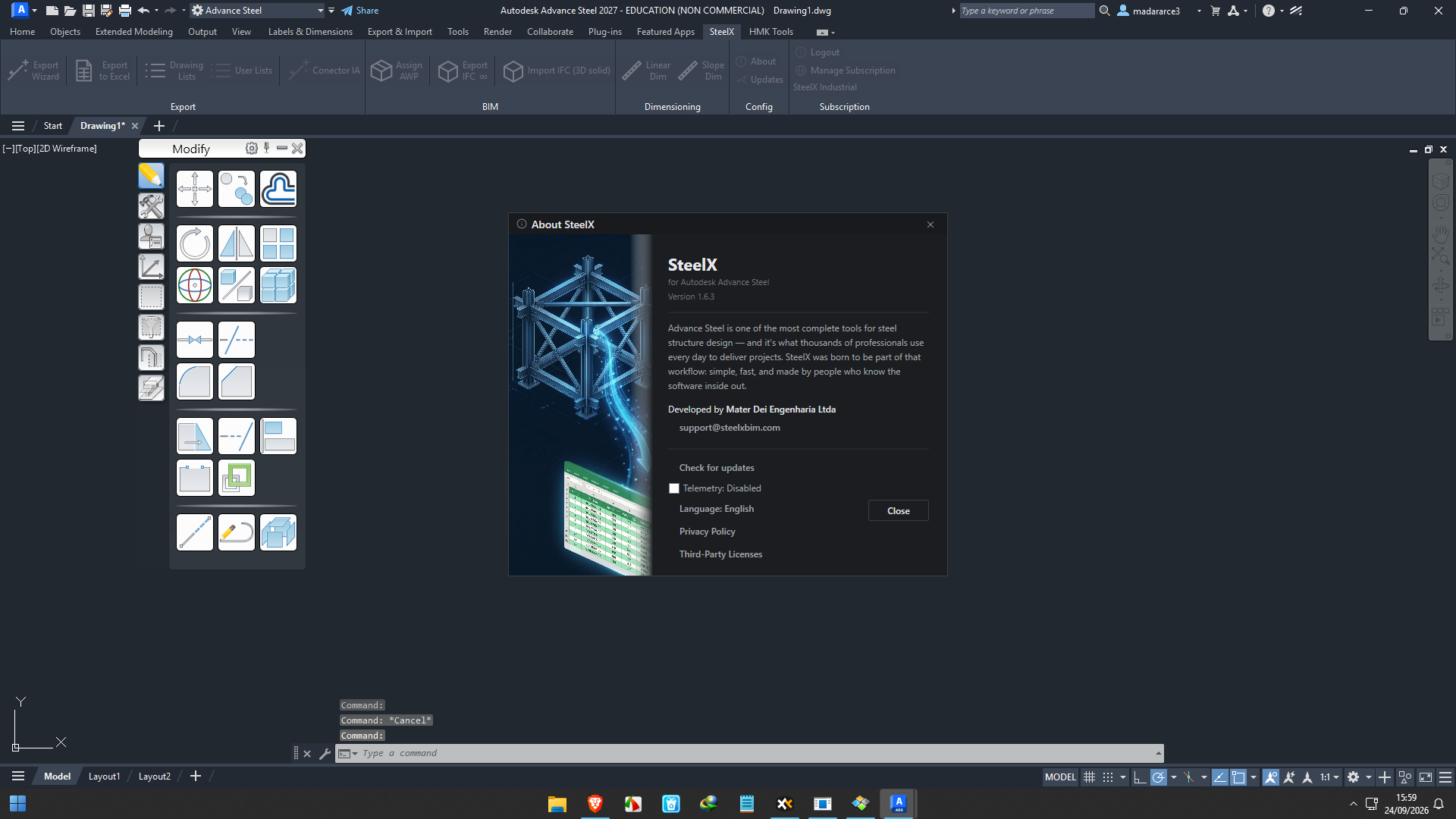
Description
Mater Dei Engenharia SteelX Industrial Review: Features, Benefits, Applications, and Performance
Software Overview
Mater Dei Engenharia SteelX Industrial 2027 is a software keyword associated with industrial steel engineering, structural design, and steel fabrication workflows. For professionals working with metal structures, industrial facilities, and steel construction projects, specialized engineering software can help organize technical information, improve design consistency, and support more efficient project execution. The value of a steel engineering solution depends on its modeling capabilities, calculation methods, documentation tools, compatibility, and suitability for the specific requirements of a project.
This review explores Mater Dei Engenharia SteelX Industrial from the perspective of engineers, steel fabricators, industrial contractors, and technical teams. It examines potential applications, important evaluation criteria, practical benefits, workflow considerations, and the factors buyers should investigate before investing in the software. Because independently verified technical specifications, current pricing, and detailed user testimonials are not established here, product-specific capabilities are distinguished from general considerations for industrial steel engineering software.
Introduction to Mater Dei Engenharia SteelX Industrial
Steel engineering projects involve much more than preparing drawings. Engineers must consider structural requirements, material properties, load conditions, connection details, fabrication tolerances, installation sequences, and project documentation. Even relatively small industrial structures can require coordination between designers, manufacturers, site engineers, and construction managers.
Mater Dei Engenharia SteelX Industrial is a product name that may interest professionals searching for dedicated tools for industrial steel engineering. When evaluating a solution in this category, the main objective is to determine whether it can support the technical and administrative demands of steel-related projects without introducing unnecessary complexity.
Consider an engineering team preparing a steel platform for an industrial facility. The project may involve columns, beams, bracing, access walkways, equipment supports, and connections. Each component must fit the intended design, satisfy applicable engineering requirements, and correspond with the information used during fabrication and installation.
A suitable engineering workflow helps teams maintain consistent information throughout these stages. It can also make design revisions easier to manage, particularly when equipment dimensions change or site conditions require modifications.
However, buyers should confirm which of these functions SteelX Industrial actually provides, rather than assuming that every capability available in industrial engineering software is included in this particular product.
Key Features to Evaluate
The following features are important when assessing Mater Dei Engenharia SteelX Industrial for professional use. Their availability should be confirmed against the current product documentation or a demonstration.
1. Industrial Steel Structure Design
Industrial steel design commonly involves platforms, support frames, equipment structures, access systems, mezzanines, and steel frameworks for manufacturing facilities.
For a project team, a useful design environment should make it possible to represent structural components clearly and maintain organized engineering information. The ability to manage component dimensions, member properties, and design revisions can be particularly valuable when several structures belong to the same project.
Before purchasing SteelX Industrial, determine which structural elements it supports and whether its workflow is appropriate for the complexity of your intended projects.
2. Engineering Calculations and Structural Verification
Structural calculations are essential to the design of safe and reliable steel structures. Engineers may need to evaluate loading conditions, member capacity, stability, deflection, and connection behavior according to the applicable design standards.
A dedicated engineering application may help organize these calculations, depending on its actual functionality. Nevertheless, users should verify whether SteelX Industrial performs structural analysis directly, assists with specific calculations, or primarily supports another part of the engineering process.
It is equally important to establish which design codes are supported, how calculation results are presented, and whether engineers can review the assumptions behind the results.
3. Technical Drawings and Documentation
Engineering documentation communicates the design to fabricators, installers, inspectors, and other project participants. Clear drawings and consistent technical information can reduce misunderstandings during manufacturing and construction.
When assessing SteelX Industrial, investigate its drawing-generation options, dimensioning tools, annotation capabilities, report formats, and revision-management workflow.
If the software supports automated documentation, determine whether the resulting drawings require substantial manual correction before they are ready for production.
4. Component and Material Management
Steel projects may include numerous profiles, plates, bolts, connection components, and material specifications. Keeping these items organized helps engineering and fabrication teams maintain consistency.
A useful industrial steel workflow should make material information accessible and help users identify component properties without repeatedly entering the same information.
Potential buyers should check whether SteelX Industrial includes material libraries, customizable profiles, component schedules, or quantity reporting. These functions should be treated as evaluation criteria until their inclusion is confirmed.
5. Design Revisions and Project Coordination
Industrial projects frequently change during development. Equipment suppliers may revise dimensions, clients may request additional access platforms, and contractors may discover installation constraints.
Efficient revision management helps teams understand what changed and which documents need updating. Before selecting SteelX Industrial, investigate how it handles modified components, updated drawings, saved project versions, and information exchange with other engineering tools.
Compatibility is especially important for companies that already use established CAD, structural analysis, or fabrication systems.
Practical Use Cases
Industrial Platforms and Equipment Supports
Manufacturing plants often require steel platforms for maintenance access, machinery support, and operator movement. These structures may contain beams, columns, handrails, stairways, and connections that must work together as a coordinated system.
For this application, engineers should prioritize accurate geometry, reliable structural verification, accessible documentation, and a clear method for communicating revisions.
SteelX Industrial may be worth evaluating for this type of work if its confirmed functions match the project’s design and documentation requirements.
Steel Frameworks for Factories and Workshops
Factories and workshops use steel frameworks to support roofs, equipment, production areas, and service installations. Designing these structures requires coordination between architectural layouts, structural members, and practical construction constraints.
Engineering software can contribute to a more organized workflow when it helps teams manage structural information and communicate design intent consistently.
Before using SteelX Industrial for an entire industrial building, confirm its scope of application, structural analysis capabilities, and suitability for the relevant building codes.
Industrial Maintenance and Modification Projects
Existing industrial facilities often require modifications rather than completely new construction. A company might need to strengthen an equipment support, extend a maintenance platform, or adapt a steel structure to accommodate replacement machinery.
In these situations, accurate existing-condition information is essential. Engineers must distinguish verified measurements from assumptions and evaluate how the proposed changes affect the overall structure.
A suitable software workflow can help organize the revised design, but it cannot replace site inspections, professional engineering judgment, or the verification of existing structural conditions.
Steel Fabrication Preparation
Fabricators need reliable information about component dimensions, material specifications, connection details, and assembly requirements.
Engineering tools that provide consistent fabrication documentation can reduce avoidable clarification requests and improve communication between design offices and workshops.
If fabrication preparation is an important part of your business, check whether SteelX Industrial produces production-ready drawings or requires additional detailing software. This distinction can significantly affect the overall cost and efficiency of the workflow.
Performance Analysis
The performance of Mater Dei Engenharia SteelX Industrial should be assessed through practical testing rather than assumptions based on its name or intended market.
Workflow Efficiency
An effective engineering application should help users complete routine tasks without unnecessary repetition. During a demonstration, create a representative project and measure the time required to prepare the initial design, revise a component, and update the associated documentation.
Also consider how easily team members can find project information and whether common operations require extensive manual work.
Accuracy and Reliability
For structural engineering, numerical accuracy and traceable assumptions are more important than an attractive interface or a fast modeling process.
Test representative calculations against independently verified examples appropriate to the software’s intended scope. Review units, boundary conditions, load combinations, design assumptions, and reported results.
Any safety-critical output must be reviewed by a qualified engineer using applicable codes and appropriate independent checks. Software results alone should not be treated as proof that a structure is safe.
Ease of Use
The learning curve affects both individual productivity and the time required to train a team. During evaluation, examine the quality of the interface, availability of technical documentation, clarity of error messages, and accessibility of frequently used functions.
A tool that closely matches an existing engineering workflow may be more valuable than one with numerous advanced options that a team rarely uses.
Compatibility and System Requirements
Before installation, verify the supported operating systems, minimum hardware requirements, licensing arrangements, file formats, and integration options.
Compatibility with existing engineering software is particularly important for companies that exchange models and drawings with external designers or fabrication partners.
Because current verified specifications are not established here, exact hardware requirements and supported integrations should be obtained from the product’s official documentation or supplier.
Pros and Cons of Mater Dei Engenharia SteelX Industrial
Every engineering application should be evaluated according to its actual capabilities, limitations, and suitability for the intended workflow. The following points identify potential advantages and considerations associated with adopting a specialized industrial steel engineering solution.
Potential Advantages
- Industry-focused workflow: Software designed around steel engineering tasks may provide a more relevant working environment than a general-purpose design application.
- Improved project organization: A structured digital workflow can help teams organize component information, design revisions, and technical documentation.
- Engineering consistency: Appropriate calculation and documentation tools can support repeatable processes when configured and used correctly.
- Support for industrial projects: Specialized tools may be useful for equipment supports, platforms, steel frameworks, and related structures, depending on the software’s confirmed scope.
- Potential productivity improvements: Reducing repetitive manual work can help engineering teams spend more time reviewing designs and coordinating project requirements.
Potential Disadvantages
- Unverified feature coverage: Buyers must confirm which design, calculation, modeling, and documentation capabilities are actually included.
- Learning requirements: Specialized software may require training before engineers can use it efficiently.
- Compatibility considerations: Integration with existing CAD, structural analysis, and fabrication applications may require additional steps or separate tools.
- Licensing uncertainty: Current prices, license restrictions, upgrade policies, and support arrangements need to be confirmed before purchase.
- Professional verification remains necessary: No engineering application eliminates the need for qualified review, appropriate design standards, and independent validation of safety-critical results.
These points are evaluation considerations rather than verified product-specific shortcomings. A hands-on demonstration is the best way to establish how well SteelX Industrial meets a particular company’s requirements.
Pricing and Plans
The current pricing and licensing structure for Mater Dei Engenharia SteelX Industrial could not be independently verified for this review. Consequently, quoting a specific purchase price, subscription fee, or license tier would risk providing inaccurate information.
Businesses considering the software should request a current quotation and clarify the following details:
- Whether the software uses a perpetual license, subscription, or another licensing model.
- Whether the license is intended for an individual workstation or multiple users.
- Whether updates and future versions are included in the purchase.
- Whether technical support and training are provided.
- Whether additional modules or integrations require separate payment.
- Whether commercial use is permitted under the proposed license.
- Whether a trial, demonstration, or evaluation license is available.
For smaller engineering offices, the most important consideration is the total cost of ownership rather than the initial price alone. Installation, training, maintenance, compatibility adjustments, and staff productivity can all influence the long-term value of an engineering application.
Larger organizations should also assess how licensing works across multiple engineers and whether the software can accommodate their project volume and documentation requirements.
Who Should Consider SteelX Industrial?
Mater Dei Engenharia SteelX Industrial may be worth investigating for professionals whose work involves industrial steel structures and related engineering activities, provided the software’s verified functions match their requirements.
Structural engineers should focus on calculation capabilities, supported design standards, and the ability to review engineering assumptions.
Steel fabricators should prioritize drawing quality, component information, material documentation, and compatibility with existing production processes.
Industrial contractors should investigate whether the application supports their design coordination and project documentation needs.
Engineering consultants should evaluate its suitability for their typical project types, client deliverables, and established technical workflows.
Students and smaller engineering teams should consider the availability of learning resources, training, and affordable licensing before committing to a new platform.
Mater Dei Engenharia SteelX Industrial 1.6.3 Download
Final Verdict
Mater Dei Engenharia SteelX Industrial is a software name worth researching for users interested in industrial steel engineering and related design workflows. However, its precise feature set, performance characteristics, licensing options, and verified customer experiences should be established before making a purchasing decision.
The broader value of specialized steel engineering software lies in its ability to support organized design processes, improve documentation consistency, reduce repetitive work, and help engineering teams coordinate their projects. These benefits depend on the actual tools provided, the quality of their implementation, and the expertise of the people using them.
For prospective buyers, the best approach is to request a product demonstration, review the technical specifications, confirm compatibility with existing systems, and test the application against a representative project. Pay particular attention to structural verification, drawing output, revision handling, and the level of manual work required to produce final deliverables.



Reviews
There are no reviews yet.