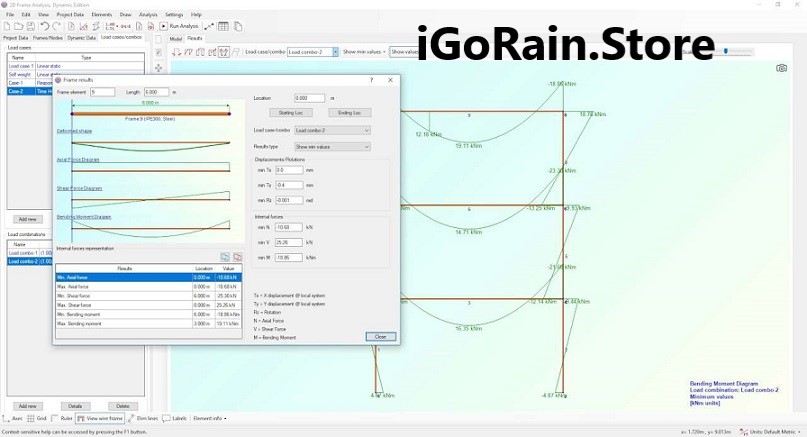
Description
2D Frame Analysis Software Review: Accurate Structural Modeling Made Practical
Summary
2D Frame Analysis software has become an essential tool for civil and structural engineers who need fast, accurate, and reliable methods to analyze planar structures such as beams, frames, and trusses. 2D Frame Analysis Download From academic learning to real-world building and industrial projects, this type of software bridges the gap between theoretical calculations and practical design decisions.
In an industry where precision directly impacts safety, cost, and compliance, 2D Frame Analysis tools offer engineers a dependable way to simulate structural behavior under various loads. Whether you are designing steel frames, reinforced concrete systems, or evaluating retrofits, this software enables engineers to visualize force distribution, detect weak points, and optimize designs before construction begins.
This review explores the core features, real-world applications, performance, advantages, limitations, and value of 2D Frame Analysis software, helping professionals determine whether it fits their engineering workflow.
Introduction
Structural engineering relies heavily on understanding how forces move through a structure. Traditional hand calculations, while valuable, become time-consuming and error-prone for complex frames with multiple members, load cases, and boundary conditions. This is where 2D Frame Analysis software proves its value.
Designed specifically for planar structural systems, 2D Frame Analysis software allows engineers to model beams, columns, and joints in two dimensions and evaluate internal forces such as bending moments, shear forces, and axial loads. The software uses proven structural analysis methods to deliver fast and consistent results that align with engineering standards.
From small consulting firms to educational institutions and large infrastructure projects, this category of software remains a foundational tool for structural design and verification.
Key Features of 2D Frame Analysis Software
Intuitive Structural Modeling
Most 2D Frame Analysis platforms focus on simplicity and clarity. Engineers can define nodes, members, supports, and material properties through a clean graphical interface. This visual modeling approach minimizes setup errors and makes it easier to validate assumptions before running an analysis.
Comprehensive Load Definition
The software supports multiple load types, including:
-
Dead loads
-
Live loads
-
Point loads
-
Distributed loads
-
Wind and seismic approximations (where applicable)
Load combinations can be defined according to standard engineering practice, allowing engineers to evaluate worst-case scenarios efficiently.
Accurate Structural Calculations
At its core, 2D Frame Analysis software performs:
-
Linear static analysis
-
Reaction force calculations
-
Bending moment diagrams
-
Shear force diagrams
-
Axial force distributions
These outputs provide engineers with a complete understanding of how forces behave throughout the structure.
Real-Time Visualization
Graphical outputs such as deflected shapes, force diagrams, and color-coded stress results help users quickly interpret data. This visual feedback is especially valuable for design reviews, client presentations, and internal quality checks.
Export and Reporting Tools
Professional-grade software includes options to export calculation reports, diagrams, and summaries. These reports support documentation needs for project approvals, audits, and compliance with engineering regulations.
Practical Use Cases
Building Frame Design
One of the most common applications of 2D Frame Analysis software is the design of building frames. Engineers use it to analyze steel or concrete frames under vertical and lateral loads, ensuring columns and beams meet strength and serviceability requirements.
Educational and Academic Use
Universities and training institutions rely on 2D Frame Analysis tools to teach structural analysis concepts. Students can experiment with different configurations and immediately see how load paths and internal forces change.
Retrofit and Structural Assessment
When assessing existing structures, engineers often lack original design documentation. 2D Frame Analysis software allows professionals to recreate structural systems and evaluate their performance under updated loading conditions.
Industrial Structures
Industrial platforms, pipe racks, and equipment support frames frequently require planar analysis. The software helps engineers ensure these systems can safely support operational loads without excessive deflection or stress.
Preliminary Design Optimization
Before committing to detailed 3D modeling, engineers often use 2D Frame Analysis software for early-stage decision-making. It helps identify efficient member sizes and layouts, saving time and reducing design iterations later.
Performance Analysis
Speed and Efficiency
2D Frame Analysis software is known for its rapid computation times. Even models with numerous members and load cases typically solve within seconds, allowing engineers to test multiple design options quickly.
Accuracy and Reliability
When used correctly, the software delivers results consistent with classical structural theory. This reliability makes it suitable for both conceptual design and detailed verification tasks.
Learning Curve
Compared to full-scale 3D structural analysis platforms, 2D Frame Analysis software is generally easier to learn. Most engineers can become productive within a short time, making it accessible for junior engineers and students.
Stability and Consistency
Modern versions are stable and capable of handling repeated analyses without performance degradation. This consistency is critical for professional environments where deadlines matter.
Pros & Cons
Pros
-
User-friendly interface suitable for beginners and professionals
-
Fast analysis and real-time feedback
-
Accurate results for planar structures
-
Ideal for education, small firms, and preliminary design
-
Clear visualization of forces and deformations
-
Lower hardware requirements compared to 3D analysis software
Cons
-
Limited to two-dimensional structures
-
Not suitable for complex spatial systems
-
Advanced nonlinear or dynamic analysis may be restricted
-
Requires engineering judgment to interpret results correctly
Pricing & Plans
Pricing for 2D Frame Analysis software varies depending on the vendor and feature set. Common options include:
-
One-time perpetual licenses
-
Annual or monthly subscriptions
-
Academic or student versions at reduced cost
-
Trial or demo editions for evaluation
In general, 2D Frame Analysis tools are more affordable than full structural suites, making them attractive for small engineering firms and individual consultants.
User Experience and Professional Feedback
Engineers often praise 2D Frame Analysis software for its clarity and practicality. Many users highlight how it simplifies complex calculations without sacrificing technical rigor. The ability to quickly modify models and instantly see updated results is frequently mentioned as a productivity booster.
Educational users appreciate how the software reinforces theoretical concepts through visual outputs. For professionals, the reliability and ease of reporting contribute to smoother workflows and improved communication with stakeholders.
SEO Keywords Naturally Integrated
Primary keyword:
-
2D Frame Analysis
Long-tail and semantic keywords:
-
2D frame analysis software
-
structural frame analysis tools
-
planar structural analysis
-
beam and frame analysis software
-
civil engineering analysis software
-
structural modeling and analysis
These keywords are woven naturally throughout the article to support search visibility without compromising readability.
2D Frame Analysis 7.2.8 Download
Final Verdict
2D Frame Analysis software remains a cornerstone of structural engineering practice. Its ability to deliver accurate, fast, and visually clear analysis makes it invaluable for both learning and professional applications. While it does not replace advanced 3D analysis platforms, it excels in its intended domain: efficient and reliable planar structural analysis.



Reviews
There are no reviews yet.