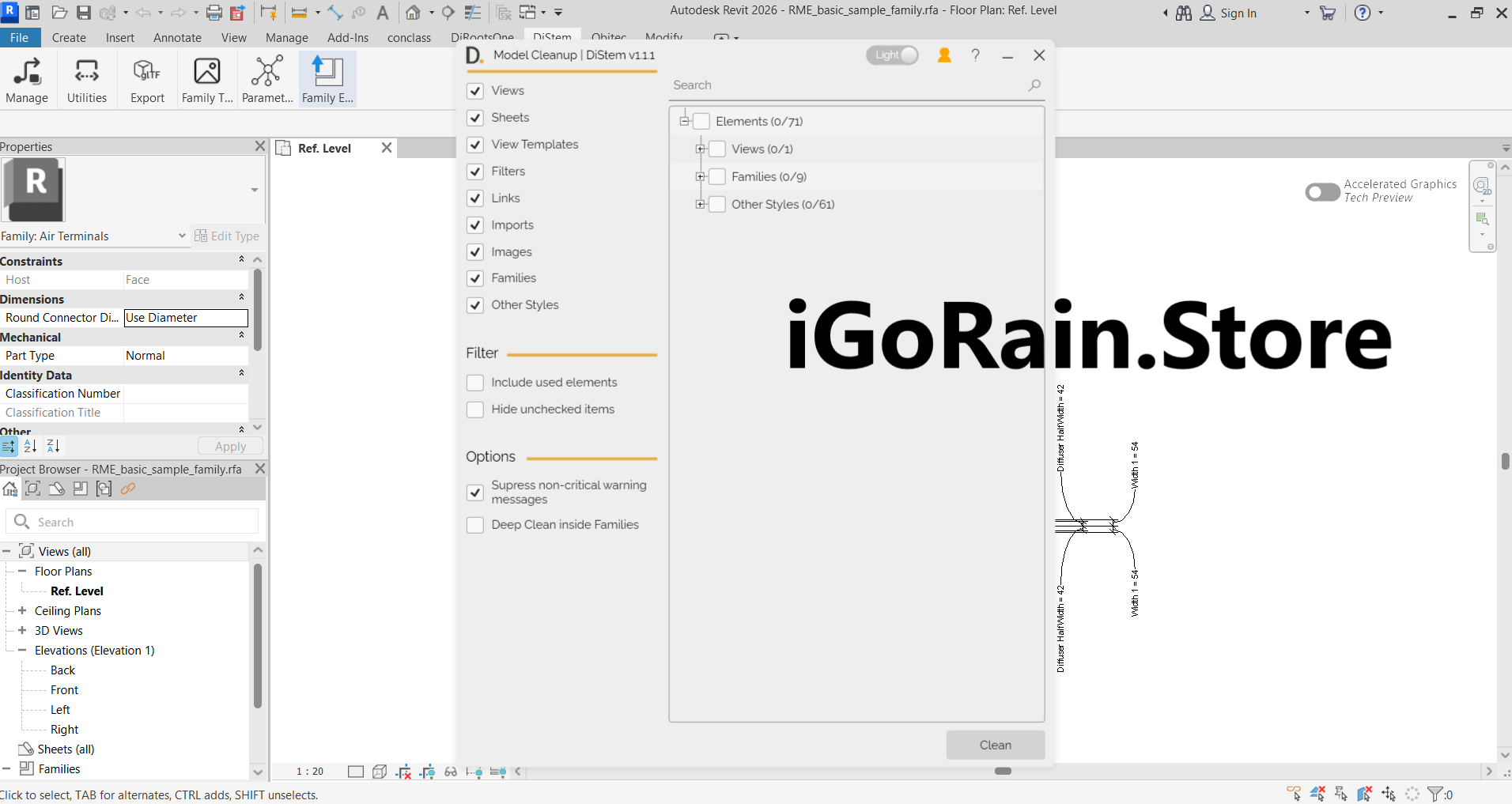
Description
DiStem for Revit Download Review: Smart Parametric Modeling for Advanced Building Design
Summary
DiStem for Revit is a specialized Building Information Modeling (BIM) Download DiStem for Revit 1.1.1 add-in that enhances Autodesk Revit’s native capabilities by introducing DiStem for Revit crack download parametric modeling, automation, and design control tools. Created to support architects, structural engineers, and BIM specialists, DiStem for Revit free download streamlines complex modeling tasks that are otherwise time-consuming or difficult to manage using standard Revit workflows.
What makes DiStem for Revit stand out is its ability to bridge the gap between conceptual design and detailed BIM execution. By enabling intelligent, rule-based geometry creation, it empowers design teams to generate accurate, flexible models while maintaining full compliance with Revit’s data structure.
In this review, we explore DiStem for Revit in detail, examining its key features, real-world applications, performance, benefits, limitations, and overall value for AEC professionals seeking greater modeling efficiency and precision.
Introduction to DiStem for Revit
Modern BIM projects demand speed, accuracy, and adaptability. As building designs become more complex, traditional manual modeling in Revit can slow teams down and increase the risk of inconsistencies. This is especially true for projects involving repetitive elements, parametric systems, or frequent design changes.
DiStem for Revit was developed to address these challenges by extending Revit’s parametric modeling capabilities. The add-in allows users to create intelligent building elements driven by parameters and logical rules rather than manual drafting. This approach enables faster iterations, improved consistency, and better coordination across disciplines.
Rather than replacing Revit’s native functionality, DiStem for Revit integrates seamlessly into existing workflows, making it a powerful enhancement rather than a disruptive change.
Key Features of DiStem for Revit
Advanced Parametric Modeling
At the core of DiStem for Revit is its ability to generate parametric building elements with a high level of control. Users can define relationships between geometry, dimensions, and constraints, allowing models to adapt dynamically when parameters change.
Key benefits include:
-
Rule-based geometry creation
-
Consistent modeling across large projects
-
Rapid design iteration without rework
-
Reduced manual input and drafting errors
Automation of Repetitive Tasks
DiStem for Revit significantly reduces time spent on repetitive modeling operations. By automating routine tasks, the software helps teams focus on design quality rather than manual adjustments.
Automation features are particularly valuable for:
-
Repetitive architectural components
-
Complex structural layouts
-
Standardized building systems
-
Large-scale projects with similar elements
Seamless Revit Integration
DiStem for Revit operates directly within the Revit environment, ensuring full compatibility with BIM standards, schedules, views, and documentation. Models created using DiStem remain native Revit elements, preserving data integrity and coordination.
This seamless integration ensures:
-
No loss of BIM data
-
Smooth collaboration with other Revit users
-
Compatibility with downstream analysis and documentation
Flexible Design Control
The add-in provides users with enhanced control over model behavior. Designers can quickly adjust parameters to test alternatives, refine geometry, or respond to client and regulatory feedback.
This flexibility supports:
-
Early-stage concept development
-
Design development optimization
-
Late-stage model refinement
Improved Model Consistency and Quality
By relying on logic-driven modeling rather than manual adjustments, DiStem for Revit helps maintain consistency across large BIM models. This improves overall model quality and reduces coordination issues during construction documentation.
Practical Use Cases of DiStem for Revit
Architectural Design and Façade Modeling
Architects use DiStem for Revit to create complex façades, modular systems, and parametric layouts that would be difficult to manage manually. Changes to dimensions or spacing can be applied instantly across the entire model.
Structural Modeling and System Layouts
Structural engineers benefit from DiStem’s ability to generate consistent framing systems, repetitive structural elements, and rule-based layouts. This improves accuracy and simplifies coordination with architectural models.
Large-Scale BIM Projects
For hospitals, commercial complexes, and residential developments, DiStem for Revit helps manage scale and complexity. Parametric rules ensure that changes are applied consistently, reducing coordination risks.
Design Iteration and Optimization
During early design stages, teams often explore multiple alternatives. DiStem for Revit allows designers to test options quickly without rebuilding models from scratch.
BIM Standardization Across Teams
Organizations seeking standardized BIM practices use DiStem for Revit to enforce consistent modeling logic across teams, improving collaboration and project deliverables.
Performance Analysis
Modeling Speed and Efficiency
DiStem for Revit significantly accelerates modeling workflows when compared to manual Revit techniques. The time savings become more pronounced on larger and more complex projects.
Reliability and Stability
The software performs reliably within Revit, producing stable models that remain fully editable. Parametric updates are applied consistently, minimizing the risk of geometry conflicts or data loss.
Scalability for Complex Models
DiStem for Revit handles complex parametric relationships effectively, making it suitable for projects with hundreds or thousands of interconnected elements.
Learning Curve
While basic usage is intuitive for experienced Revit users, advanced parametric workflows may require an initial learning period. However, this investment is quickly offset by productivity gains.
Pros and Cons
Pros
-
Enhances Revit’s native parametric capabilities
-
Automates repetitive modeling tasks
-
Improves consistency and model quality
-
Ideal for large and complex BIM projects
-
Fully integrated within Revit workflows
-
Supports rapid design iteration
Cons
-
Requires familiarity with parametric concepts
-
Advanced features may take time to master
-
Best suited for professional BIM users
Pricing and Licensing Overview
DiStem for Revit is typically offered under professional licensing models suitable for design firms and BIM consultancies. Pricing may vary depending on:
-
License type (subscription or perpetual)
-
Number of users
-
Support and update options
For teams working extensively in Revit, the productivity benefits often outweigh the investment cost.
User Experience and Industry Feedback
Users frequently highlight DiStem for Revit’s ability to simplify complex modeling tasks and reduce repetitive work. Many professionals note that once integrated into daily workflows, it becomes an essential productivity tool rather than an optional add-on.
Firms also report improved collaboration and reduced coordination issues due to more consistent and predictable model behavior.
DiStem for Revit 2026 Download
Final Verdict
DiStem for Revit is a powerful BIM enhancement tool that brings advanced parametric control, automation, and efficiency to Revit-based workflows. It is particularly valuable for professionals dealing with complex geometries, large projects, or frequent design changes.
While it requires some investment in learning parametric modeling principles, the long-term benefits in productivity, consistency, and design flexibility make it a strong addition to any serious BIM toolkit.




Reviews
There are no reviews yet.