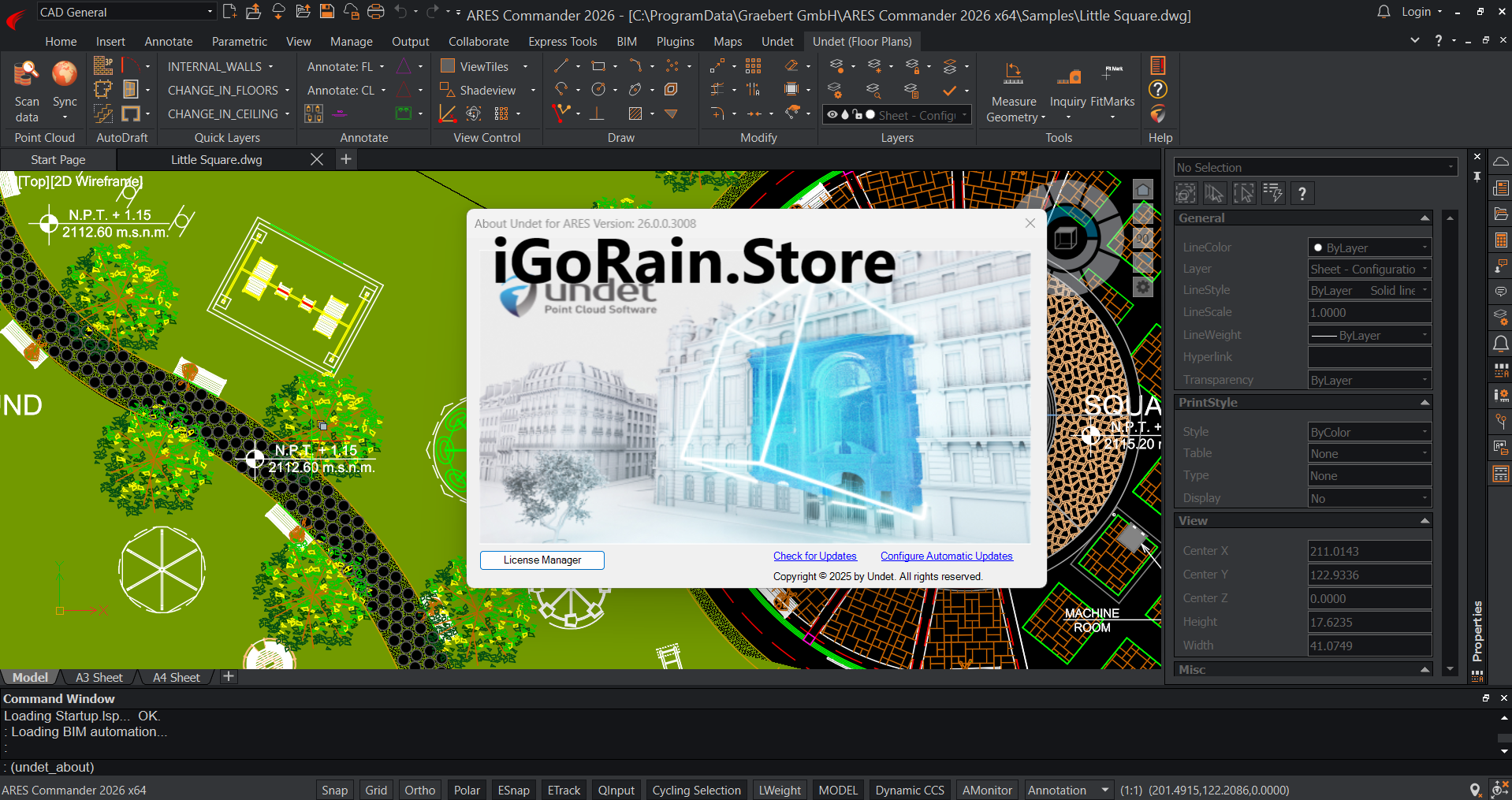
Description
Undet for ARES: Advanced Underground Utility Detection and Mapping Software Review
Summary: A Professional-Grade Solution for Accurate Underground Utility Intelligence
Underground utility detection has become one of the most critical challenges in modern construction, infrastructure development, and urban planning. Mistakes in identifying buried utilities can lead to costly delays, safety hazards, and regulatory issues. Undet for ARES positions itself as a powerful, specialized software solution designed to transform how professionals process, visualize, and interpret underground utility data directly within the ARES CAD environment.
Built for surveyors, civil engineers, utility mappers, and infrastructure consultants, Undet for ARES bridges the gap between field-collected geophysical data and precise CAD-based documentation. Rather than relying on fragmented workflows or manual data interpretation, this software enables users to create accurate, standardized underground utility maps with improved confidence and clarity.
In this in-depth review, we explore Undet for ARES from a real-world, professional perspective, covering its features, performance, use cases, strengths, limitations, and overall value.
Introduction: Why Underground Utility Mapping Demands Specialized Software
Underground infrastructure is becoming denser and more complex every year. From water and gas pipelines to electrical conduits and fiber optic cables, modern projects often involve navigating layers of unseen assets beneath the surface.
Traditional CAD tools are not designed to interpret geophysical survey data such as GPR (Ground Penetrating Radar) outputs or electromagnetic detection results. This is where Undet for ARES stands apart. It is purpose-built to process underground detection data and convert it into clear, CAD-ready utility representations without forcing professionals to leave their familiar design environment.
By integrating directly with ARES, Undet enables a streamlined workflow that saves time, reduces interpretation errors, and improves documentation quality.
Key Features of Undet for ARES
Native Integration with ARES CAD
One of the most valuable aspects of Undet for ARES is its seamless integration. Users can work entirely inside the ARES interface, avoiding file conversion issues or disconnected workflows. This native compatibility enhances productivity and reduces the learning curve for CAD professionals.
Advanced GPR Data Interpretation
Undet for ARES supports the processing and interpretation of Ground Penetrating Radar data, allowing users to visualize subsurface features accurately. Detected utilities can be traced, classified, and validated with confidence, reducing ambiguity in underground mapping.
Intelligent Utility Classification
The software enables structured classification of detected utilities based on type, depth, confidence level, and detection method. This aligns well with industry standards for underground utility engineering and improves communication between project stakeholders.
Clear 2D and 3D Visualization
Undet for ARES allows users to visualize underground utilities in both plan and profile views. This is especially useful for complex sites where multiple utilities overlap at different depths.
Automated Drawing Tools
Manual drafting of underground utilities is time-consuming and prone to error. Undet automates much of this process, generating clean, standardized CAD drawings that are ready for project documentation or client delivery.
Data Validation and Quality Control
The software includes tools to verify detection confidence and consistency, helping professionals comply with best practices and regulatory expectations.
Practical Use Cases: How Professionals Use Undet for ARES in the Field
Civil Engineering and Road Design
Civil engineers use Undet for ARES to identify potential conflicts between proposed road alignments and existing underground utilities. Early detection helps avoid costly redesigns and construction delays.
Utility Mapping and Surveying
Surveyors rely on Undet for ARES to transform field detection data into professional utility maps. The software’s structured workflow ensures that data is documented accurately and consistently.
Urban Infrastructure Projects
In dense urban environments, undocumented utilities are a major risk. Undet helps infrastructure consultants visualize complex underground networks, improving planning accuracy and safety.
Construction Risk Mitigation
Construction firms use Undet-generated drawings to reduce the likelihood of utility strikes. Accurate underground mapping improves on-site decision-making and protects both workers and assets.
Municipal Asset Management
Local authorities and utility owners use Undet for ARES to maintain reliable underground utility records, supporting long-term infrastructure planning and maintenance.
Performance Analysis: Accuracy, Speed, and Reliability
Accuracy
Undet for ARES excels in translating detection data into precise CAD representations. The software’s interpretation tools help users differentiate between real utilities and noise, leading to more reliable outputs.
Speed and Workflow Efficiency
By eliminating the need for multiple software tools, Undet significantly accelerates the underground mapping process. Tasks that previously required manual interpretation and redrawing can now be completed in a fraction of the time.
Stability and Usability
In professional environments, software stability is critical. Undet for ARES performs reliably within ARES, even when handling complex datasets. The interface is logical, with tools clearly organized for practical use.
Learning Curve
While Undet is a specialized tool, users with CAD experience typically adapt quickly. The software is designed for professionals, not casual users, but it rewards investment in learning with substantial productivity gains.
Pros and Cons of Undet for ARES
Pros
-
Seamless integration with ARES CAD
-
Purpose-built for underground utility detection workflows
-
Accurate interpretation of GPR and detection data
-
Professional-grade visualization and documentation
-
Improves safety and reduces project risk
-
Supports industry-standard utility mapping practices
Cons
-
Designed for professionals, not beginners
-
Requires access to reliable detection data for best results
-
More specialized than general CAD tools
Pricing and Plans
Pricing for Undet for ARES typically depends on licensing structure and organizational requirements. It is positioned as a professional solution rather than a low-cost utility, reflecting its specialized capabilities and industry focus.
For engineering firms, survey companies, and infrastructure consultants, the return on investment is often justified by time savings, reduced errors, and improved project outcomes.
EEAT Perspective: Why Undet for ARES Builds Trust
Experience
Undet for ARES is clearly developed with real-world underground utility workflows in mind. Its tools reflect practical challenges faced by surveyors and engineers in the field.
Expertise
The software demonstrates deep technical understanding of geophysical detection methods and CAD documentation standards, reinforcing its credibility among professionals.
Authority
Undet’s adoption within professional utility mapping environments positions it as an authoritative solution rather than a generic add-on.
Trust
Consistent performance, accurate outputs, and structured workflows help users rely on Undet for high-stakes infrastructure projects.
Final Verdict: Is Undet for ARES Worth It?
Undet for ARES is a powerful, purpose-driven solution for professionals who take underground utility detection seriously. It is not designed to be a generic CAD extension or a casual mapping tool. Instead, it delivers real value to engineers, surveyors, and consultants who need accuracy, efficiency, and confidence when working with underground infrastructure data.


Reviews
There are no reviews yet.