Description
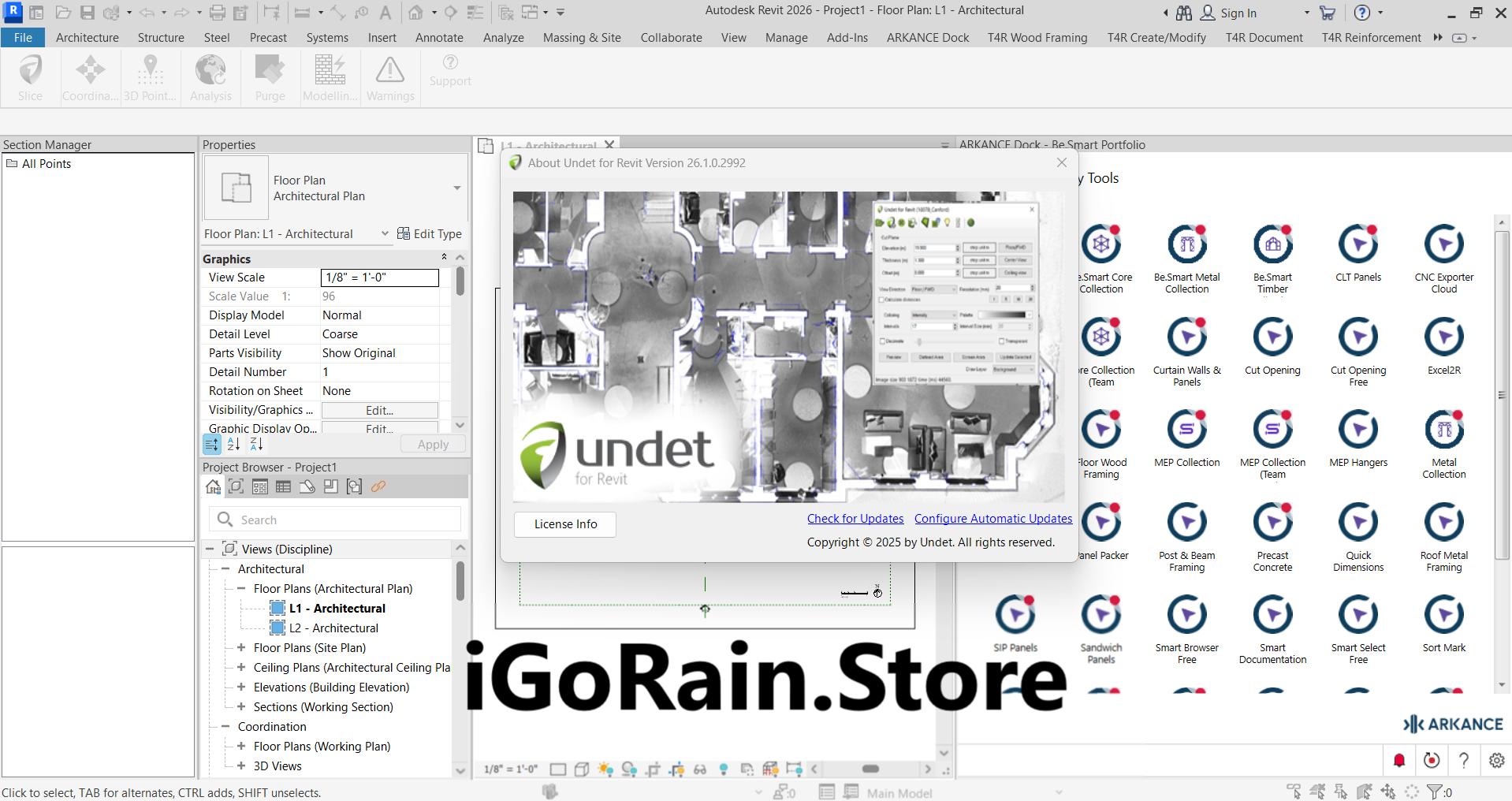
Undet for Revit Download 26.1.0.2992:
Summary:
As Building Information Modeling (BIM) becomes Undet for Revit 26 Download the backbone of modern construction and infrastructure projects, one critical challenge continues to stand out accurately representing Download Undet for Revit 26.1.0.2992 underground utilities. Missing or incorrect subsurface data can lead to clashes, costly redesigns, safety incidents, and construction delays. Download Undet for Revit 26.1.0.2992 addresses this challenge head-on by enabling professionals to detect, interpret, and model underground utilities directly within Autodesk Revit.
Designed for civil engineers, BIM specialists, surveyors, and infrastructure consultants, Undet for Revit transforms raw underground detection data into structured, intelligent BIM objects. Instead of working with disconnected 2D drawings or external files, teams can now integrate subsurface utilities seamlessly into coordinated BIM models.
In this in-depth review, we explore how Undet for Revit performs in real-world projects, its practical benefits, strengths, limitations, and whether it delivers genuine value for professional users.
Introduction: Why Underground Utilities Matter in BIM Projects
Modern construction projects are no longer limited to what is visible above ground. Beneath every building, road, or infrastructure corridor lies a dense network of pipes, cables, ducts, and conduits. Ignoring or inaccurately modeling these assets can result in severe project risks.
Traditional BIM workflows often rely on assumptions, outdated records, or simplified representations of underground utilities. Undet for Revit changes this by allowing accurate subsurface data to become part of the BIM environment itself. This approach supports better coordination, safer designs, and more informed decision-making throughout the project lifecycle.
For organizations committed to BIM accuracy and risk reduction, Undet for Revit represents a specialized yet essential extension to standard Revit capabilities.
Key Features of Undet for Revit
Native Integration with Autodesk Revit
Undet for Revit operates directly within the Revit environment, eliminating the need for external processing tools. This native integration ensures consistency, improves workflow efficiency, and allows underground utilities to behave like true BIM elements rather than static drawings.
Underground Utility Detection Data Interpretation
The software is built to work with geophysical detection data such as Ground Penetrating Radar and electromagnetic surveys. Detected utilities can be interpreted, traced, and validated before being modeled in Revit, significantly reducing uncertainty.
Intelligent BIM-Based Utility Modeling
Instead of simple lines or annotations, Undet creates structured utility objects with depth, geometry, and classification. These objects integrate naturally into Revit’s BIM ecosystem, supporting coordination, scheduling, and clash detection.
Utility Classification and Confidence Levels
Users can assign attributes such as utility type, detection method, depth, and confidence level. This structured data approach improves transparency and aligns with industry best practices for underground utility engineering.
Plan, Profile, and 3D Visualization
Undet for Revit allows professionals to view underground utilities in plan views, profiles, and full 3D models. This multi-perspective visualization helps teams understand complex subsurface conditions more clearly.
Clash Detection and Coordination Support
Once utilities are modeled, they can be coordinated against foundations, slabs, piles, and other structural elements. This proactive approach helps identify conflicts early, long before construction begins.
Practical Use Cases: How Undet for Revit Is Used in Real Projects
BIM Coordination for Complex Buildings
In commercial and institutional projects, Undet for Revit helps BIM teams integrate underground utilities into federated models. This reduces clashes between foundations and existing services and supports smoother coordination meetings.
Infrastructure and Civil Engineering Projects
Civil engineers use Undet for Revit to model utilities beneath roads, bridges, and urban infrastructure. Accurate subsurface BIM models support better alignment decisions and reduce redesign efforts.
Construction Risk Management
Contractors rely on Undet-generated models to minimize the risk of utility strikes. Having verified underground utilities in the BIM model improves site planning and safety.
Urban Redevelopment and Brownfield Sites
In redevelopment projects where records are incomplete or unreliable, Undet for Revit allows teams to incorporate newly detected utilities into the BIM model, improving confidence in planning decisions.
Public Sector and Municipal Projects
Municipalities and public agencies use Undet for Revit to maintain more accurate digital records of underground assets, supporting long-term infrastructure management.
Performance Analysis: Precision, Workflow Efficiency, and Reliability
Modeling Accuracy
Undet for Revit excels at converting detection data into accurate BIM representations. The ability to model depth and geometry directly in Revit improves spatial accuracy compared to traditional 2D approaches.
Workflow Speed
By keeping the entire process within Revit, Undet reduces the need for repetitive imports, redraws, and manual coordination. This streamlined workflow translates into measurable time savings on complex projects.
Stability and Scalability
The software performs reliably even on large BIM models with multiple linked disciplines. This makes it suitable for enterprise-level projects where performance and stability are critical.
Learning Curve
While Undet for Revit is a specialized professional tool, BIM users familiar with Revit typically adapt quickly. The interface aligns well with standard BIM workflows, minimizing disruption.
Pros and Cons of Undet for Revit
Pros
-
Seamless integration with Autodesk Revit
-
Accurate BIM-based modeling of underground utilities
-
Supports GPR and detection data interpretation
-
Improves clash detection and coordination
-
Enhances project safety and risk management
-
Aligns with BIM standards and best practices
Cons
-
Designed for professional and enterprise users
-
Requires reliable detection data for best accuracy
-
More specialized than standard Revit tools
Pricing and Plans
Pricing for Undet for Revit typically follows a professional licensing model based on organizational needs and project scale. While it is positioned as a premium solution, its value lies in reduced project risk, improved coordination, and long-term efficiency gains.
For firms regularly working with underground infrastructure, the cost is often justified by preventing even a single major utility-related incident.
EEAT Evaluation: Why Undet for Revit Builds Professional Confidence
Experience
Undet for Revit clearly reflects real-world experience in underground utility engineering and BIM coordination. Its tools address practical problems encountered on live projects.
Expertise
The software demonstrates deep expertise in geophysical data interpretation, underground utility standards, and BIM modeling principles.
Authority
Undet is positioned as a specialized solution used by professionals who require accuracy and accountability in subsurface modeling.
Trust
Consistent performance, structured data handling, and integration with Revit help build trust among engineers, BIM managers, and project stakeholders.
Download Undet for Revit 2026 Developer
Download Undet for Revit 26.1.0.2992 Download
Final Verdict: Who Should Use Undet for Revit?
Undet for Revit is a highly specialized BIM solution designed for professionals who need reliable underground utility representation inside their Revit models. It is not a general-purpose add-on, but rather a focused tool that delivers significant value in projects where underground conditions matter.
For BIM-driven organizations involved in infrastructure, construction, or urban development, Undet for Revit provides clarity where uncertainty is usually the norm.



Reviews
There are no reviews yet.