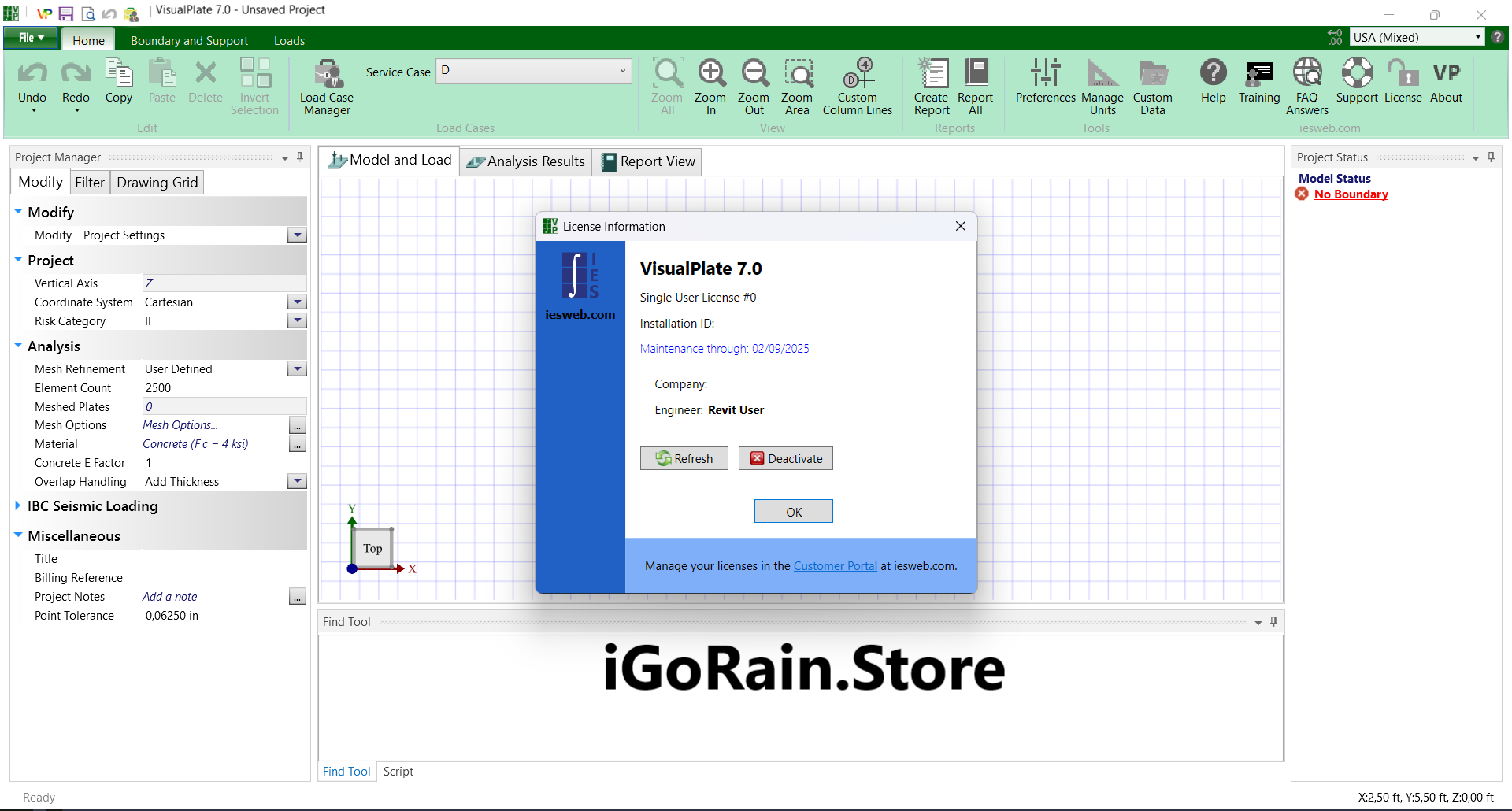
Description
VisualPlate Software Review – Advanced Plate and Structural Element Analysis for Engineers
Summary
VisualPlate is a specialized engineering software developed to analyze plate structures, slabs, and surface elements within structural systems. Designed primarily for structural and civil engineers, the software provides a powerful platform for evaluating stresses, deflections, and load distribution across plate-like components used in buildings, bridges, industrial equipment, and infrastructure projects.
Modern structural engineering often involves analyzing elements that behave as plates rather than simple beams or columns. These elements—such as concrete slabs, steel plates, foundation mats, and structural panels—experience complex forces that require advanced analytical tools to evaluate accurately. VisualPlate simplifies this process by offering a graphical modeling environment combined with robust structural analysis capabilities.
By allowing engineers to model plate structures, apply loads, and visualize results in an intuitive interface, VisualPlate improves both efficiency and accuracy in engineering design workflows. Instead of relying on simplified manual calculations, engineers can simulate real-world conditions and better understand how structural plates respond to various load scenarios.
In this comprehensive review, we will explore VisualPlate in detail, including its features, practical engineering applications, performance capabilities, advantages, limitations, and overall value for structural analysis professionals.
Introduction to VisualPlate
Structural engineering projects frequently involve elements that distribute loads across surfaces rather than along single lines. Slabs, plates, and shell elements are common in modern construction and industrial design.
Examples include:
- Concrete floor slabs in buildings
- Steel plates in structural frames
- Bridge deck panels
- Foundation slabs
- Structural floor systems
Analyzing these components can be complex because loads distribute in multiple directions across the surface. Traditional beam analysis methods are often insufficient for accurately predicting structural behavior in such cases.
VisualPlate was developed to address this challenge.
The software enables engineers to model plate structures and perform detailed structural analysis using advanced computational techniques. By simulating loads and boundary conditions, VisualPlate calculates stresses, deflections, and reaction forces across the entire surface of a structural plate.
This type of analysis helps engineers ensure that structural plates perform safely and efficiently under real-world conditions.
VisualPlate is commonly used in structural engineering firms, consulting companies, infrastructure design teams, and academic research environments where precise plate analysis is required.
Key Features of VisualPlate
VisualPlate includes a range of powerful tools designed to support accurate plate and slab analysis for engineering professionals.
Graphical Plate Modeling
One of the most valuable aspects of VisualPlate is its graphical modeling interface. Engineers can create plate geometries directly within the workspace without relying on complex command-line inputs.
Users can easily define:
- Plate shapes and boundaries
- Support conditions
- Structural constraints
- Load application points
The graphical environment makes it easier to visualize the structural model and make adjustments during the design process.
This intuitive modeling approach improves efficiency and reduces errors during setup.
Advanced Load Application
Structural plates must be evaluated under a variety of load conditions. VisualPlate allows engineers to apply different types of loads across the plate surface.
Common load types include:
- Uniform distributed loads
- Concentrated point loads
- Line loads
- Pressure loads
- Thermal loads
The software calculates how these loads affect the plate structure, providing detailed insight into stress distribution and deformation.
Finite Element Analysis Capabilities
VisualPlate uses finite element analysis techniques to simulate structural behavior accurately.
Finite element methods divide the plate surface into smaller elements, allowing the software to calculate stresses and deflections across the entire structure with high precision.
This approach provides engineers with detailed analysis results that help identify potential structural weaknesses or areas requiring reinforcement.
Stress and Deflection Visualization
Understanding structural behavior is easier when analysis results are presented visually.
Visual Plate provides graphical outputs that illustrate how forces affect the plate structure. Engineers can view:
- Stress contour diagrams
- Deflection plots
- Reaction forces
- Load distribution patterns
These visualizations help engineers quickly interpret complex analysis data and make informed design decisions.
Support for Multiple Materials
Structural plates can be constructed from various materials depending on the project requirements.
Visual Plate supports analysis for several material types, including:
- Reinforced concrete slabs
- Structural steel plates
- Composite structural elements
- Aluminum panels
Engineers can assign material properties within the model to ensure accurate structural simulations.
Engineering Calculation Reports
Engineering projects require clear documentation of structural analysis and design decisions.
Visual Plate can generate professional calculation reports that include:
- Model descriptions
- Load definitions
- Structural analysis results
- Stress and deflection summaries
These reports help engineers present their work to clients, regulatory authorities, and project teams.
Practical Use Cases
Visual Plate is used in many engineering disciplines where plate structures play an important role.
Concrete Slab Analysis for Buildings
Concrete floor slabs are common in residential, commercial, and industrial buildings.
Structural engineers use VisualPlate to analyze how these slabs distribute loads from occupants, furniture, and equipment while ensuring that stress levels remain within safe limits.
Bridge Deck Analysis
Bridge decks behave like large plate structures that must support vehicle loads and environmental forces.
VisualPlate helps engineers simulate these loads and evaluate how the deck structure responds under different traffic and environmental conditions.
Steel Plate Structural Components
Many industrial structures include steel plates that function as load-bearing elements.
Engineers can use VisualPlate to analyze these plates and verify that they meet structural design requirements.
Foundation Mat Analysis
Large buildings often use mat foundations that distribute loads across wide areas of soil.
VisualPlate can analyze these foundation plates to determine how loads transfer into the soil and whether the structure remains stable.
Research and Educational Applications
Universities and research institutions often use plate analysis software to teach structural mechanics concepts.
VisualPlate provides a visual platform where students can explore how loads affect plate behavior and develop a deeper understanding of structural engineering principles.
Performance Analysis
When evaluating engineering software, performance is critical in terms of modeling efficiency, analysis accuracy, and system stability.
Efficient Modeling Workflow
The graphical modeling tools in VisualPlate allow engineers to create structural models quickly and make design adjustments with minimal effort.
This reduces setup time and improves overall workflow efficiency.
Accurate Structural Analysis
By using finite element analysis techniques, VisualPlate provides detailed structural results that engineers can rely on for professional design decisions.
These results help engineers identify potential design issues early in the project.
Stability with Complex Models
Engineering projects often involve large structural models with multiple loads and constraints.
VisualPlate is designed to handle these complex scenarios while maintaining reliable performance.
Learning Curve
Engineers familiar with structural analysis concepts can typically learn VisualPlate relatively quickly.
However, beginners may require some time to fully understand advanced analysis tools and modeling techniques.
Pros and Cons
Like any engineering software, VisualPlate has both advantages and limitations.
Pros
- Specialized tools for plate and slab analysis
- Graphical modeling interface for easier setup
- Advanced finite element analysis capabilities
- Clear visualization of stress and deflection results
- Supports multiple structural materials
- Generates professional engineering calculation reports
- Suitable for complex structural analysis projects
Cons
- Requires structural engineering knowledge to use effectively
- Advanced analysis features may take time to master
- Large models may require high-performance computer systems
- Primarily focused on plate structures rather than full building modeling
Despite these limitations, VisualPlate remains a powerful tool for structural plate analysis.
Pricing and Plans
VisualPlate is typically offered as professional structural analysis software with various licensing options.
Pricing structures may depend on factors such as:
- Software version
- Licensing type
- Professional or educational usage
- Access to technical support and updates
Engineering firms often purchase individual licenses for engineers or multi-user licenses for larger design teams.
Since pricing models may change, users should verify the latest licensing options through their software provider.
Who Should Use VisualPlate?
VisualPlate is designed for professionals involved in structural engineering and advanced structural analysis.
The software is particularly valuable for:
- Structural engineers
- Civil engineering consultants
- Infrastructure design professionals
- Engineering research institutions
- Engineering students and educators
Anyone responsible for analyzing plate structures or surface-based structural elements can benefit from the capabilities of VisualPlate.
Final Verdict
VisualPlate is a powerful engineering software solution designed specifically for analyzing plate structures, slabs, and structural surface elements. By combining advanced finite element analysis with an intuitive graphical interface, the software enables engineers to evaluate complex structural behavior with accuracy and confidence.



Reviews
There are no reviews yet.