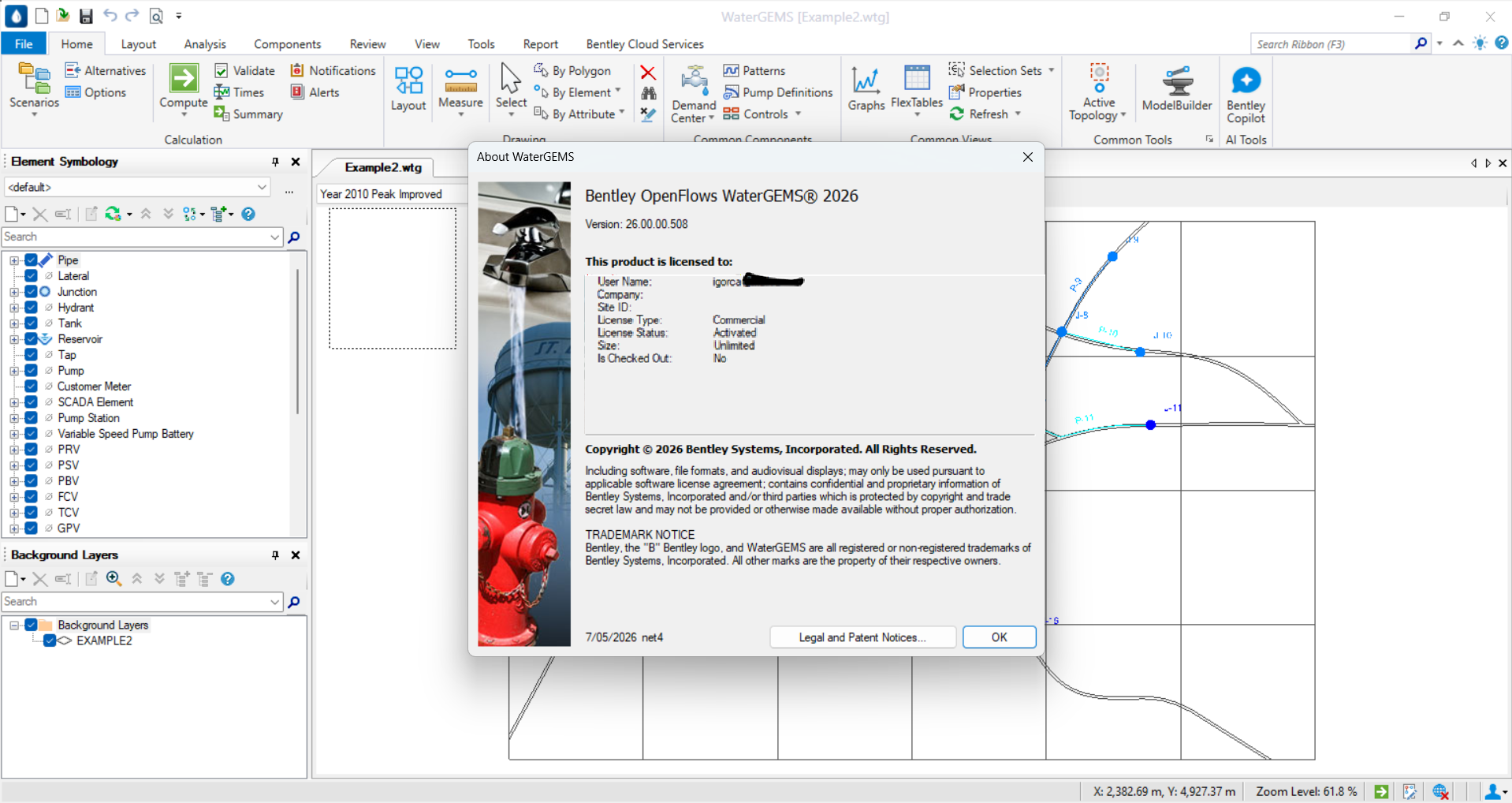
Description
Bentley OpenFlows Water Review: Advanced Water Distribution Modeling for Smarter Network Design
Summary
For engineers, water utilities, municipalities, and infrastructure consultants, designing and managing a reliable water distribution network requires more than spreadsheets and basic calculations. Bentley OpenFlows Water provides a powerful engineering environment for analyzing, modeling, and optimizing water systems, helping professionals understand how networks behave under real-world conditions.
From pressure zones and pump stations to pipes, tanks, valves, fire flow, and demand scenarios, Bentley OpenFlows Water is designed to support complex water distribution analysis. Its ability to handle detailed hydraulic modeling makes it especially valuable for professionals working on large municipal systems, industrial water networks, and infrastructure improvement projects.
The biggest advantage of Bentley OpenFlows Water is its practical engineering focus. Instead of relying on assumptions, users can build digital models of existing or proposed water networks, test different operating conditions, identify potential problems, and make better design decisions before construction begins.
For organizations that need accurate water distribution system modeling software, Bentley OpenFlows Water remains a serious solution for improving system reliability, planning network upgrades, and supporting data-driven infrastructure decisions.
Introduction
Water distribution systems are often more complicated than they appear. A network may contain hundreds or thousands of pipes, multiple pumps, storage tanks, pressure zones, control valves, and changing customer demands. A small change in one part of the system can affect pressure and flow across the entire network.
This is where hydraulic modeling software becomes essential.
Bentley OpenFlows Water is built to help engineers analyze water distribution networks in a digital environment. Rather than testing every possible scenario in the field, professionals can create a hydraulic model and evaluate how the network is expected to perform under different conditions.
For example, an engineer may need to answer questions such as:
- Will a new residential development receive sufficient water pressure?
- What happens if a major pipe fails?
- Can an existing pump station support future demand?
- Where are pressure losses occurring?
- Can a new storage tank improve system performance?
- Will the network provide adequate fire flow?
- Which pipes should be upgraded first?
Bentley OpenFlows Water helps answer these questions through structured hydraulic analysis, scenario testing, and engineering workflows.
What Is Bentley OpenFlows Water?
Bentley OpenFlows Water is a professional water distribution modeling solution used for planning, designing, analyzing, and managing pressurized water networks.
It is aimed primarily at:
- Water utility engineers
- Civil and hydraulic engineers
- Municipal infrastructure departments
- Engineering consultants
- Industrial facility designers
- Water network planners
- Infrastructure asset management teams
The software can be used to model components such as pipes, junctions, pumps, tanks, reservoirs, valves, and other network elements. Engineers can then analyze hydraulic behavior based on demand, elevation, pipe characteristics, operating conditions, and other design parameters.
One of the key strengths of the Bentley OpenFlows Water workflow is its ability to support both existing network analysis and future infrastructure planning. Users can evaluate current system performance while also creating proposed design alternatives.
Key Features of Bentley OpenFlows Water
1. Advanced Hydraulic Modeling
At the core of Bentley OpenFlows Water is hydraulic analysis. Engineers can model how water flows through a pressurized network and evaluate important parameters such as:
- Flow rates
- Pressure
- Head loss
- Hydraulic grade
- Pipe velocity
- Pump performance
- Tank levels
- System demand
This allows professionals to identify weak points in a water distribution system before they become expensive operational problems.
2. Water Distribution Network Design
Designing a new network requires careful consideration of pipe sizes, pressure requirements, elevation changes, demand projections, and future growth.
Bentley OpenFlows Water can help engineers compare design alternatives and determine whether proposed infrastructure is capable of meeting expected requirements.
For example, an engineering team designing a new development can test several pipe configurations and evaluate the expected pressure at different locations. This provides a more reliable basis for selecting pipe diameters and network layouts.
3. Pump and Pump Station Analysis
Pump stations are critical components of many water systems. Poorly selected pumps can lead to excessive energy consumption, inadequate pressure, or unstable system operation.
Bentley OpenFlows Water supports pump-related analysis, helping users evaluate how pump operation interacts with the rest of the network.
Engineers can investigate:
- Pump operating conditions
- System head requirements
- Flow behavior
- Pump efficiency considerations
- Multiple pump configurations
- Operational scenarios
This is particularly useful when planning upgrades to existing pump stations or evaluating future demand.
4. Pressure and Flow Analysis
Maintaining appropriate pressure is one of the most important responsibilities in water network design.
Too little pressure can result in poor service, while excessive pressure can increase leakage and place unnecessary stress on infrastructure.
Bentley OpenFlows Water enables users to analyze pressure throughout the network and identify areas that may require:
- Larger pipes
- Pressure-reducing valves
- Booster pumps
- Additional storage
- Network reconfiguration
This makes the software valuable for both new construction and rehabilitation projects.
5. Scenario and Alternative Analysis
Real-world water networks rarely operate under one fixed condition. Demand changes throughout the day, seasons change, equipment may be unavailable, and future developments can alter system requirements.
Scenario modeling allows engineers to test different conditions without rebuilding the entire model.
Common scenarios may include:
- Average day demand
- Maximum day demand
- Peak hour demand
- Fire flow conditions
- Pump failure
- Pipe shutdown
- Future population growth
- Emergency operating conditions
This type of analysis helps infrastructure teams prepare for both expected and unexpected situations.
6. Fire Flow Analysis
Fire protection requirements are an important part of water distribution planning.
A network may appear to perform well during normal demand but experience significant pressure drops during fire flow conditions. Bentley OpenFlows Water can help engineers assess whether critical locations have sufficient available flow and pressure.
This provides valuable information for municipalities, developers, and consultants working on commercial, residential, and industrial projects.
7. Integration with Engineering Workflows
Bentley OpenFlows Water is designed for professional infrastructure workflows. Depending on the project environment and connected Bentley technologies, engineers can work with engineering data and network information more efficiently.
This is particularly useful for organizations managing large infrastructure projects where design, analysis, mapping, and asset information need to work together.
Practical Use Cases
Municipal Water Distribution Planning
Municipalities often need to understand whether existing water networks can support population growth.
An engineering department can use Bentley OpenFlows Water to model current infrastructure and then create future demand scenarios. This helps identify areas where additional capacity may be required.
Instead of waiting until pressure problems appear, planners can evaluate infrastructure needs in advance.
New Residential and Commercial Developments
Developers and civil engineering consultants can use water distribution modeling software to verify whether a proposed development can connect successfully to an existing network.
The model can help evaluate:
- Proposed pipe sizes
- Connection points
- Pressure availability
- Storage requirements
- Future demand
This can reduce design uncertainty and improve coordination between engineers and approving authorities.
Water Utility Network Rehabilitation
Aging water systems often contain sections with insufficient capacity, high pressure, or operational limitations.
Bentley OpenFlows Water can assist utility teams in comparing rehabilitation strategies. For example, an engineer may evaluate whether replacing a pipe, adding a parallel line, or modifying valve operations provides the best improvement.
This approach can help organizations prioritize investment more effectively.
Pump Station Optimization
A utility may discover that a pump station is operating inefficiently or struggling to meet peak demand.
By modeling different pump configurations and operational scenarios, engineers can gain a clearer understanding of system performance before making expensive equipment changes.
Emergency and Failure Analysis
Water infrastructure must continue operating even when individual components fail.
Engineers can simulate conditions such as:
- A closed pipe
- Pump failure
- Tank outage
- Valve operation
- Reduced supply capacity
This supports more effective emergency planning and improves understanding of network resilience.
Performance Analysis
In professional hydraulic modeling, performance is about more than simply producing results quickly. Accuracy, model flexibility, scenario management, and the ability to handle complex infrastructure are equally important.
Bentley OpenFlows Water performs strongly in these areas.
For small and medium-sized networks, users can typically build and analyze models efficiently. Larger networks require more structured data preparation and careful model management, but the software is designed for serious engineering workloads.
A major performance advantage is the ability to evaluate multiple operating conditions. Engineers can compare scenarios rather than relying on a single simplified calculation.
The software is especially valuable when the project requires detailed analysis of:
- Complex pipe networks
- Multiple pressure zones
- Pump stations
- Storage facilities
- Variable demand
- Fire flow conditions
- Future expansion
However, the quality of the results depends heavily on the quality of the input data. A hydraulic model is only as reliable as its network geometry, elevation information, demand data, pipe characteristics, and operational assumptions.
For this reason, experienced users should always validate model results against available field information where possible.
User Experience and Learning Curve
Bentley OpenFlows Water is professional engineering software, so new users should expect a learning curve.
A beginner who has never worked with hydraulic modeling may need time to understand:
- Network model construction
- Hydraulic principles
- Boundary conditions
- Demand allocation
- Pump curves
- Scenario management
- Result interpretation
However, engineers with experience in water distribution systems will generally find the software much easier to approach.
The most effective workflow is to start with a relatively small network model. Once users understand how network elements interact, they can gradually move toward larger and more complex projects.
In practical use, the software’s greatest benefit comes when engineers use it as a decision-support tool rather than simply treating it as a calculation engine. The real value lies in asking better engineering questions and testing multiple possible solutions.
Pros and Cons
Pros
- Powerful hydraulic modeling capabilities
- Suitable for complex water distribution networks
- Supports detailed pressure and flow analysis
- Useful for pump station and storage analysis
- Helps evaluate future demand scenarios
- Valuable for fire flow and emergency analysis
- Supports infrastructure planning and rehabilitation
- Designed for professional engineering workflows
- Suitable for municipal and consulting environments
Cons
- May require training for new users
- Professional engineering knowledge is recommended
- Complex models require accurate input data
- Advanced workflows can feel overwhelming for casual users
- Licensing and enterprise deployment may require careful planning
Pricing and Plans
The pricing of Bentley Open Flows Water can vary depending on licensing structure, product configuration, subscription arrangements, organization size, and the specific Bentley software environment being used.
Professional engineering software is commonly offered through commercial licensing models that may differ between individual users, organizations, and enterprise customers.
Because pricing can change based on requirements and licensing terms, buyers should evaluate the exact product configuration and usage needs before making a purchasing decision.
For a professional engineering company, the cost should be considered alongside the potential savings from improved design decisions, reduced construction risks, better network planning, and more efficient infrastructure investment.
Who Should Use Bentley OpenFlows Water?
Bentley OpenFlows Water is best suited for users who need professional water distribution system modeling and analysis capabilities.
It is particularly appropriate for:
- Municipal water authorities
- Civil engineering firms
- Hydraulic consultants
- Infrastructure planners
- Utility network managers
- Industrial facility engineers
- Large-scale development projects
It may be more than necessary for users who only need basic pipe calculations or simple spreadsheet-based analysis.
Bentley Openflows Water Developer
Final Verdict
Bentley OpenFlows Water is a powerful solution for professionals who need to understand, design, and improve pressurized water distribution networks.
Its strongest advantage is the ability to move beyond basic calculations and analyze how a complete network behaves under different operating conditions. From pressure and flow analysis to pump stations, fire flow, future demand, and emergency scenarios, the software provides engineers with a structured environment for making better infrastructure decisions.
For a water utility planning a network upgrade, a consultant designing a new development, or a municipality preparing for future population growth, Bentley OpenFlows Water can provide valuable insight before major construction or investment decisions are made.
The software does require technical knowledge and accurate data, but that is expected from a professional hydraulic modeling platform. Users who invest time in learning the workflow can gain a powerful tool for improving water distribution system design and planning.




Reviews
There are no reviews yet.