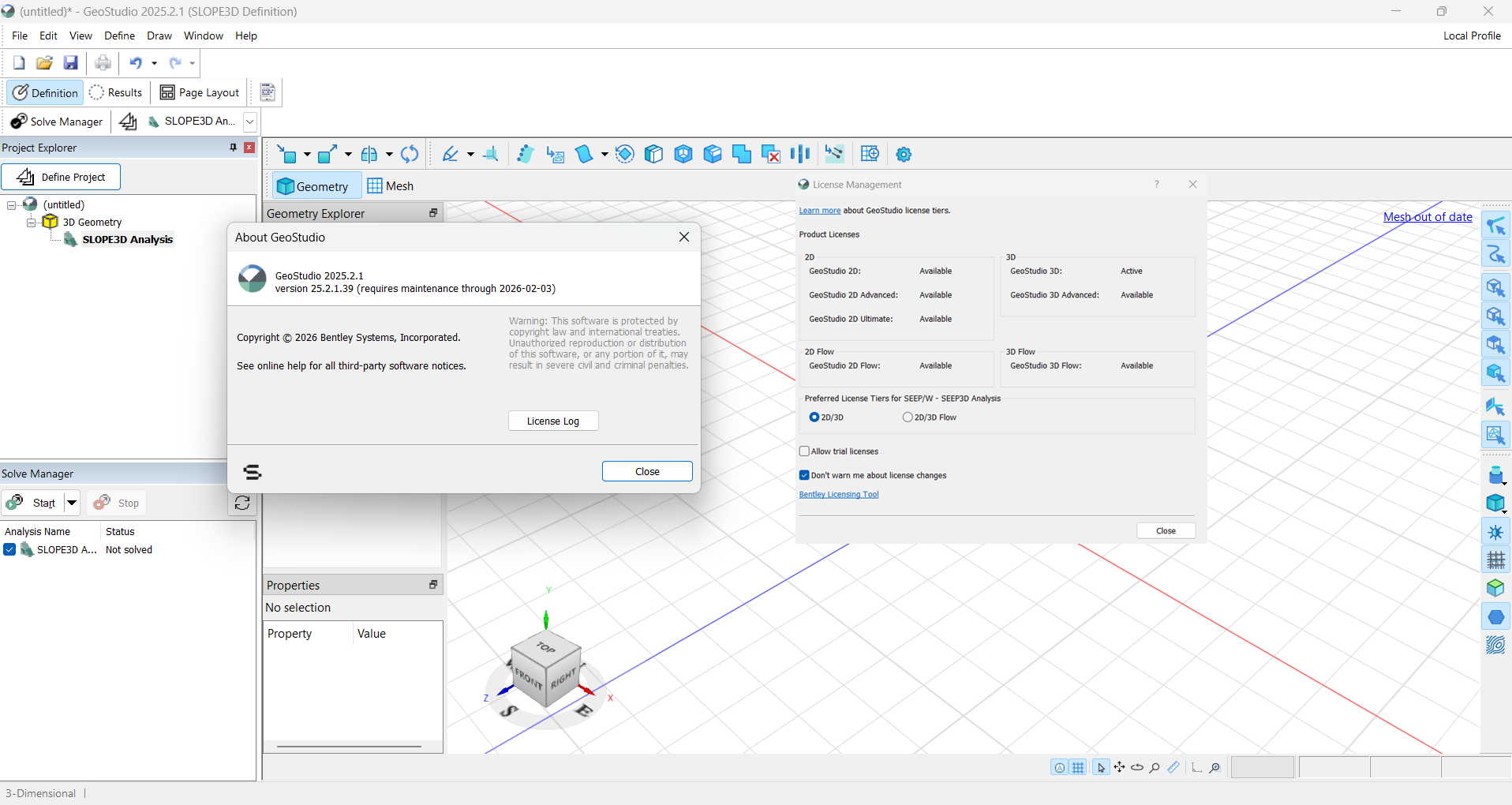
Description
Seequent GeoStudio 2025.2.1: Advanced Geotechnical Modeling Software for Soil, Water, and Stability Analysis
Seequent GeoStudio is one of the most respected geotechnical engineering software platforms for analyzing complex soil, rock, groundwater, and environmental conditions. Designed for engineers, researchers, consultants, and infrastructure professionals, GeoStudio brings powerful numerical modeling tools into a unified environment. From slope stability and seepage analysis to stress-deformation modeling and dynamic earthquake simulations, the software helps users understand how ground conditions behave under real-world pressures.
What makes Seequent GeoStudio particularly valuable is its practical engineering focus. Instead of relying only on simplified calculations, users can build detailed models based on site conditions, material properties, groundwater levels, loading conditions, and construction stages. This makes the platform useful for projects where accuracy and confidence are essential, including dams, embankments, highways, tunnels, foundations, mines, and natural slopes.
For professionals searching for advanced geotechnical analysis software, slope stability analysis software, or finite element modeling tools for soil and groundwater, Seequent GeoStudio offers a comprehensive solution. Its combination of specialized analysis modules, visual modeling, and professional reporting makes it a strong choice for both routine engineering assessments and highly complex geotechnical investigations.
Introduction
Geotechnical engineering often involves working with conditions that cannot be seen directly. Soil layers may vary across a site, groundwater can change over time, and slopes may respond differently to rainfall, excavation, construction loads, or earthquakes. A small change in one variable can sometimes significantly affect the safety of an entire project.
This is where advanced engineering software becomes essential.
Seequent GeoStudio is built to help engineers model and understand these complex interactions. Rather than treating soil and water as isolated factors, the platform allows users to analyze how different geotechnical conditions interact. Engineers can study seepage, pore-water pressure, slope failure, soil deformation, stress distribution, and other important behaviors using numerical simulation.
A typical workflow might begin with a cross-section of a proposed embankment. The engineer defines the soil layers, assigns material properties, sets groundwater conditions, and applies relevant loads. The model can then be analyzed to identify potential failure surfaces, water movement, deformation patterns, or changes in stability.
For professionals who need more than basic spreadsheet calculations, GeoStudio provides a structured environment for developing detailed and repeatable geotechnical models.
What Is Seequent GeoStudio?
Seequent GeoStudio is a suite of geotechnical engineering analysis tools used for modeling soil, rock, groundwater, and structural interactions. The platform is widely associated with numerical methods such as finite element analysis and limit equilibrium analysis.
Depending on the specific configuration and available modules, users can perform different types of analysis, including:
- Slope stability analysis
- Seepage and groundwater modeling
- Stress and deformation analysis
- Consolidation studies
- Dynamic and earthquake analysis
- Thermal and coupled geotechnical simulations
- Soil-structure interaction studies
The software is especially useful when engineering problems involve multiple variables. For example, an embankment may need to be analyzed for both groundwater seepage and slope stability. A dam may require an assessment of pore-water pressure, deformation, and seismic loading. GeoStudio supports workflows where these engineering factors can be studied in a connected modeling environment.
Key Features of Seequent GeoStudio
1. Advanced Slope Stability Analysis
Slope stability is one of the most common applications of GeoStudio. Engineers can evaluate natural slopes, excavations, road cuts, embankments, tailings facilities, and other earth structures.
The software can help identify potential failure mechanisms and calculate factors of safety under different conditions. Users can compare multiple scenarios, such as:
- Normal groundwater conditions
- Heavy rainfall
- Rapid drawdown
- Excavation or construction loading
- Seismic activity
- Changes in soil strength
This is particularly valuable for projects where the stability of a slope can change over time.
2. Seepage and Groundwater Modeling
Water movement through soil is a major concern in geotechnical engineering. Excessive seepage can increase pore-water pressure, reduce effective stress, and contribute to slope or foundation problems.
GeoStudio provides tools for analyzing groundwater flow and seepage behavior. Engineers can model conditions such as:
- Saturated and unsaturated soil
- Groundwater tables
- Drainage systems
- Seepage through embankments
- Water flow around excavations
- Hydraulic gradients
The ability to visualize pressure and flow conditions makes complex groundwater problems easier to understand.
3. Finite Element Analysis for Soil and Rock
For more advanced investigations, GeoStudio supports numerical modeling of stress, strain, and deformation. This allows engineers to examine how soil and rock respond to applied loads and changing conditions.
Finite element modeling can be useful for:
- Foundation loading
- Excavation support
- Embankment construction
- Settlement analysis
- Retaining structures
- Soil improvement projects
Instead of simply calculating a final result, engineers can study how a system behaves throughout different stages of loading or construction.
4. Coupled Analysis Capabilities
One of the platform’s major strengths is its ability to support interconnected geotechnical analyses. In real-world engineering, one event often affects several conditions at the same time.
For example, rainfall may increase groundwater levels, which can raise pore-water pressure and reduce slope stability. Similarly, construction may change stress conditions and cause deformation.
Coupled modeling helps engineers evaluate these relationships more realistically than isolated calculations.
5. Construction Stage Modeling
Many engineering projects develop gradually. A road embankment is built in layers. An excavation becomes deeper in stages. A dam is constructed progressively.
Seequent GeoStudio can be used to analyze these stages, helping engineers understand how conditions evolve during construction. This can provide valuable insight into:
- Progressive settlement
- Changes in stress
- Temporary instability
- Groundwater response
- Deformation during loading
For large infrastructure projects, this type of analysis can support better construction planning and risk management.
6. Clear Visualization and Result Interpretation
Advanced numerical analysis can generate large amounts of data. GeoStudio helps users interpret results through graphical models and visual outputs.
Depending on the analysis, users may be able to review:
- Contours
- Flow lines
- Pressure distributions
- Deformation patterns
- Stress zones
- Potential failure surfaces
- Factor of safety results
Good visualization is especially important when presenting technical findings to clients, project managers, regulators, or other stakeholders who may not work with numerical models every day.
Practical Use Cases
Slope Stability and Landslide Assessment
Geotechnical consultants can use GeoStudio to evaluate unstable natural slopes and landslide-prone areas. By modeling soil layers, groundwater conditions, and terrain geometry, engineers can assess potential failure zones.
For example, a hillside near a road may appear stable during dry conditions but become vulnerable after prolonged rainfall. A seepage and stability analysis can help demonstrate how changing water conditions affect the factor of safety.
Dams and Embankments
Dams and earth embankments require detailed analysis because groundwater movement and internal pressures can strongly affect structural safety.
GeoStudio can support studies involving:
- Seepage through earth dams
- Pore-water pressure
- Embankment stability
- Rapid drawdown
- Construction staging
- Long-term deformation
This makes it a valuable tool for both design and safety evaluation.
Roads, Railways, and Infrastructure
Transportation infrastructure frequently crosses variable ground conditions. Cut slopes, fills, embankments, and drainage systems must all be evaluated carefully.
Engineers can use GeoStudio to study potential settlement, slope stability, seepage, and deformation around transportation corridors.
This can help improve design decisions before construction begins.
Mining and Tailings Facilities
Mining projects often involve large earth structures and complex groundwater conditions. Tailings dams, waste rock piles, and open-pit slopes can require advanced geotechnical modeling.
GeoStudio can help engineers evaluate different loading, water, and material scenarios to support safer designs and improved risk assessment.
Excavation and Foundation Projects
Deep excavations and heavily loaded foundations can change the stress state of surrounding soil. Numerical modeling helps engineers investigate how the ground may respond.
Potential applications include:
- Basement excavations
- Retaining systems
- Foundation settlement
- Groundwater drawdown
- Excavation-induced deformation
Performance Analysis
In practical use, Seequent GeoStudio is best suited to professionals who need serious analytical capabilities rather than a simple calculator-based workflow.
The platform performs particularly well when users need to compare multiple design scenarios. Engineers can modify soil parameters, groundwater levels, loading conditions, or geometry and then evaluate how those changes affect the results.
The visual modeling environment also improves workflow efficiency. Instead of manually calculating every scenario, users can build a model and test different assumptions systematically.
However, performance depends heavily on model complexity and computer hardware. Large finite element models with multiple stages and coupled analyses may require more processing time than basic stability calculations.
Another important factor is model quality. The software can produce highly detailed results, but those results are only as reliable as the input data. Accurate soil parameters, realistic boundary conditions, and appropriate engineering assumptions remain essential.
This is an important point for new users: advanced software does not replace engineering judgment. It enhances it.
User Experience and Learning Curve
Experienced geotechnical engineers often appreciate GeoStudio because its tools are designed around real engineering workflows. Once users understand the modeling concepts, the platform can become a powerful part of daily analysis work.
New users may initially face a learning curve. Numerical modeling requires an understanding of:
- Soil behavior
- Boundary conditions
- Material properties
- Mesh generation
- Numerical convergence
- Result interpretation
The learning process is worthwhile for professionals who regularly perform advanced geotechnical analysis. The software’s visual approach can also make complex concepts easier to understand compared with purely command-line or spreadsheet-based methods.
A good workflow is to begin with simple models, verify results using hand calculations or established engineering methods, and gradually progress to more complex simulations.
Pros and Cons
Pros
- Comprehensive geotechnical analysis capabilities
- Strong tools for slope stability and seepage modeling
- Supports advanced numerical analysis
- Useful for complex soil and groundwater problems
- Suitable for infrastructure, mining, dams, and environmental projects
- Excellent visualization of engineering results
- Supports scenario comparison and construction-stage analysis
- Professional-level modeling capabilities
Cons
- May be more advanced than necessary for simple calculations
- Requires geotechnical engineering knowledge
- Some advanced analyses may require significant computing resources
- Licensing and module availability can vary
- New users may need time to become comfortable with numerical modeling
Pricing and Plans
The cost of Seequent GeoStudio can vary depending on the selected modules, licensing arrangement, user requirements, and commercial or organizational plan. Because professional geotechnical software is often offered through different licensing options, pricing may depend on whether the software is used by an individual engineer, consulting company, academic institution, or large enterprise.
Users should evaluate which analysis capabilities they actually need before selecting a plan. A professional working primarily on slope stability may require a Seequent Geo Studio different configuration from a large organization performing coupled finite element, groundwater, and dynamic analyses.
When considering the overall value, it is useful to look beyond the initial software cost. The ability to improve design confidence, reduce repetitive calculations, compare alternatives, and identify potential risks earlier can provide significant value on complex engineering projects.
Who Should Use Seequent GeoStudio?
Seequent GeoStudio is particularly suitable for:
- Geotechnical engineers
- Civil engineering consultants
- Geological and geotechnical researchers
- Dam and embankment specialists
- Mining engineers
- Infrastructure design teams
- Environmental engineers
- Universities and research institutions
- Organizations performing advanced soil and groundwater analysis
It may be excessive for users who only need basic bearing capacity calculations or simple slope checks. However, for complex projects involving multiple interacting geotechnical conditions, its capabilities can be extremely valuable.
Final Verdict
Seequent GeoStudio remains a powerful choice for professionals who need reliable, detailed, and flexible geotechnical modeling capabilities. Its strength comes from the way it allows engineers to investigate complex relationships between soil, water, stress, deformation, and stability.
Whether the project involves a potentially unstable slope, a major embankment, a dam, a deep excavation, a mining facility, or a complex groundwater problem, GeoStudio provides the analytical tools needed to explore different scenarios and make better-informed engineering decisions.
The software does require technical knowledge and a willingness to learn numerical modeling principles. However, that learning investment can pay off significantly for professionals who regularly work with challenging geotechnical conditions.
For anyone searching for professional geotechnical engineering software, slope stability analysis software, finite element analysis for soil, or advanced groundwater and seepage modeling tools, Seequent GeoStudio deserves serious consideration. Its combination of specialized analysis, visualization, and practical engineering workflows makes it a strong solution for modern geotechnical analysis.




Reviews
There are no reviews yet.