Description
Bentley OpenFlows Sewer 26.0: Advanced Sewer Network Modeling for Smarter Infrastructure Design
Designing, analyzing, and managing sewer networks is one of the most demanding tasks in civil and water infrastructure engineering. A small mistake in hydraulic calculations can lead to surcharge conditions, flooding, poor pipe sizing, or expensive redesigns. This is where Bentley OpenFlows Sewer stands out as a powerful solution for engineers, consultants, municipalities, and infrastructure professionals who need reliable tools for wastewater collection system modeling.
Bentley OpenFlows Sewer is designed to help professionals model sanitary and combined sewer networks, evaluate hydraulic performance, analyze system capacity, and make better engineering decisions. Its ability to work with complex sewer systems, rainfall and inflow conditions, hydraulic calculations, and real-world infrastructure data makes it a valuable tool for modern wastewater planning.
For engineering teams working on urban drainage, municipal sewer upgrades, new developments, or network rehabilitation, Bentley OpenFlows Sewer offers a structured environment for understanding how sewer systems behave under different conditions. While the software has a learning curve and may be more advanced than necessary for very small projects, its depth and professional capabilities make it a strong choice for serious sewer network analysis.
Introduction to Bentley OpenFlows Sewer
Wastewater infrastructure is rarely simple. A sewer network may include hundreds or thousands of pipes, manholes, pumps, storage structures, outfalls, and interconnected drainage areas. Engineers must understand how these components interact during normal operation and under demanding flow conditions.
Traditional spreadsheet-based calculations can be useful for small systems, but they become difficult to manage as projects grow. Bentley OpenFlows Sewer provides a dedicated hydraulic modeling environment that allows users to build a digital representation of a sewer system and evaluate its performance.
The software is particularly useful for:
- Sanitary sewer system design
- Combined sewer network analysis
- Capacity assessment
- Sewer rehabilitation planning
- Hydraulic modeling
- Urban wastewater infrastructure planning
- Development impact studies
- Flooding and surcharge investigations
Instead of relying solely on isolated calculations, engineers can analyze the network as a connected system. This helps reveal bottlenecks and hydraulic problems that may not be obvious when individual pipes are evaluated separately.
Key Features of Bentley OpenFlows Sewer
Advanced Sewer Network Modeling
One of the main strengths of Bentley OpenFlows Sewer is its ability to model complex wastewater collection networks. Users can represent pipes, manholes, junctions, outfalls, pumps, storage facilities, and other hydraulic components within a connected system.
This approach makes it easier to understand the behavior of the complete network rather than analyzing individual elements independently.
Hydraulic Analysis and Capacity Evaluation
A central purpose of Bentley OpenFlows Sewer is to evaluate hydraulic performance. Engineers can study flow conditions, pipe capacity, water levels, surcharge risks, and other important network characteristics.
This type of analysis can help answer practical questions such as:
- Can the existing sewer network handle projected flows?
- Which pipes are approaching their capacity limits?
- Where are surcharge conditions likely to occur?
- Will a new development overload the existing system?
- What happens during peak flow events?
These insights can support more informed design and infrastructure investment decisions.
Support for Different Flow Conditions
Sewer networks experience changing flows throughout the day and during different weather conditions. Depending on the project requirements and available data, engineers can analyze a range of flow scenarios.
This is especially important for systems affected by:
- Peak sanitary flows
- Wet-weather inflow
- Infiltration
- Storm-related hydraulic conditions
- Future population growth
- Industrial or commercial flow changes
Scenario-based modeling helps engineering teams compare current conditions with future requirements.
Network Visualization
Large sewer networks can be difficult to understand through tables alone. Bentley OpenFlows Sewer provides a visual modeling environment that helps users see how system components are connected.
A visual representation makes it easier to identify:
- Low-capacity sections
- Critical junctions
- Hydraulic bottlenecks
- Flow directions
- Problematic network areas
- Potential upgrade locations
For many professionals, this visual approach is one of the most practical advantages of specialized hydraulic modeling software.
Data Integration and Engineering Workflows
Modern infrastructure projects often rely on data from multiple sources, including GIS platforms, CAD drawings, surveys, databases, and existing asset records.
Bentley OpenFlows Sewer is designed to support engineering workflows that involve existing infrastructure data and digital design information. This can reduce the need to manually recreate large networks from scratch, depending on the project environment and available data sources.
Better data integration can save time, particularly when working with established municipal networks.
Scenario and Alternative Analysis
A sewer system rarely has only one possible solution. Engineers may need to compare different pipe sizes, alignments, pumping arrangements, storage options, or rehabilitation strategies.
With scenario-based analysis, users can evaluate alternatives before construction begins.
For example, a design team might compare:
- Increasing pipe capacity
- Adding a pumping station
- Introducing storage
- Redirecting flows
- Upgrading selected network sections
- Managing projected future demand
This allows teams to evaluate the engineering and financial implications of different strategies.
Practical Use Cases
Municipal Sewer Network Planning
Municipalities often manage aging sewer infrastructure that must serve growing populations. Bentley OpenFlows Sewer can help engineers evaluate whether existing networks have sufficient capacity for current and future demand.
A municipality planning a residential expansion, for example, can model the expected additional wastewater flows and determine whether downstream infrastructure requires upgrades.
New Residential and Commercial Developments
Developers and consulting engineers need to demonstrate that proposed developments can connect safely to existing sewer systems.
Bentley OpenFlows Sewer can support studies involving:
- New subdivisions
- Apartment complexes
- Commercial districts
- Industrial facilities
- Mixed-use developments
The model can help determine whether the receiving sewer network can handle additional flows without creating unacceptable hydraulic problems.
Sewer Capacity Studies
A common challenge for infrastructure owners is determining where existing systems are reaching their limits. Instead of replacing large portions of a network unnecessarily, engineers can use hydraulic analysis to identify specific problem areas.
This supports a more targeted approach to infrastructure investment.
Rehabilitation and Upgrade Projects
Aging pipes may suffer from reduced capacity, structural deterioration, infiltration, or operational problems. A hydraulic model can help engineers determine which improvements will provide the greatest benefit.
Possible rehabilitation strategies may include:
- Pipe replacement
- Capacity upgrades
- Flow diversion
- Pump improvements
- Storage solutions
- Network reconfiguration
Investigation of Sewer Flooding
When flooding or sewer surcharge occurs, the cause is not always obvious. The problem may be related to insufficient pipe capacity, downstream restrictions, excessive inflow, or a combination of factors.
Bentley OpenFlows Sewer can help engineers investigate system behavior and evaluate possible solutions using a structured modeling process.
A Real-World Workflow Experience
Imagine a consulting engineer working on a growing urban district. The existing sewer network appears to operate normally under average conditions, but residents have reported localized flooding during intense rainfall.
A basic inspection may identify several possible causes, but it may not reveal how the entire network behaves under different flow conditions.
Using Bentley OpenFlows Sewer, the engineer can create or import a model of the existing system, define relevant flow inputs, review network performance, and test possible improvements. The analysis may reveal that a specific downstream section is creating a hydraulic restriction.
Instead of recommending a costly upgrade across the entire district, the engineering team can focus on the critical section and compare several improvement strategies.
This is where hydraulic modeling provides practical value. It helps transform a complex infrastructure problem into a series of measurable engineering decisions.
Performance Analysis
Bentley OpenFlows Sewer is best suited to professional engineering environments where accuracy, network complexity, and scenario analysis are important.
Modeling Capability
The software performs strongly when working with complex sewer systems. Its value increases as projects become larger and more interconnected.
For small, straightforward calculations, the platform may feel more advanced than necessary. However, for municipal and consulting projects, its network-level modeling capabilities can significantly improve the analysis process.
Workflow Efficiency
Once users become familiar with the interface and modeling methodology, the software can make complex studies more organized. Engineers can build models, test scenarios, analyze results, and document findings within a more structured workflow.
The initial learning period should not be underestimated. New users may need time to understand hydraulic concepts, data requirements, model setup, and result interpretation.
Visualization and Interpretation
A strong hydraulic model is only useful if engineers can understand its results. Visual network analysis can make it easier to identify problem areas and communicate findings to project stakeholders.
This is especially valuable when presenting technical conclusions to clients, municipalities, planners, or decision-makers who may not work with hydraulic models every day.
Reliability for Professional Projects
For professional sewer design and infrastructure planning, model reliability depends on more than the software itself. The quality of the input data, assumptions, calibration, boundary conditions, and engineering judgment all matter.
Bentley OpenFlows Sewer can provide a powerful analytical framework, but experienced users should always validate model results against available field information and project requirements.
Pros and Cons
Pros
- Powerful sewer network modeling capabilities
- Suitable for complex municipal and infrastructure projects
- Supports hydraulic analysis and capacity assessment
- Useful for evaluating multiple design scenarios
- Helps identify bottlenecks and surcharge risks
- Strong visualization for network analysis
- Valuable for planning, rehabilitation, and future growth studies
- Designed for professional engineering workflows
Cons
- May require significant training for new users
- Advanced features can be more than small projects require
- Accurate results depend heavily on reliable input data
- Professional software licensing may be a major investment
- Complex models require careful setup and engineering review
Bentley OpenFlows Sewer Pricing and Plans
Pricing for Bentley Open Flows Sewer can vary depending on the licensing model, subscription arrangement, organization size, user requirements, and the specific Bentley software package or commercial agreement involved.
Because professional engineering software pricing may change over time, organizations should evaluate the current licensing options directly through their approved Bentley sales or procurement channel.
For businesses, consulting firms, and municipalities, the most important consideration is often the overall return on investment. If the software helps prevent overdesign, identify infrastructure bottlenecks, improve planning, or reduce costly construction changes, its value can extend well beyond the initial software cost.
Organizations should also consider:
- Number of required users
- Project frequency
- Existing Bentley software investments
- Training requirements
- Data and workflow compatibility
- Support and maintenance needs
Who Should Use Bentley OpenFlows Sewer?
Bentley OpenFlows Sewer is particularly well suited for:
- Civil engineers
- Water and wastewater consultants
- Municipal engineering departments
- Infrastructure planners
- Utility owners
- Sewer network designers
- Environmental engineering teams
- Large development projects
- Infrastructure asset management professionals
It may be less suitable for users who only need occasional basic pipe calculations or simple manual drainage estimates.
Bentley OpenFlows Sewer Developer
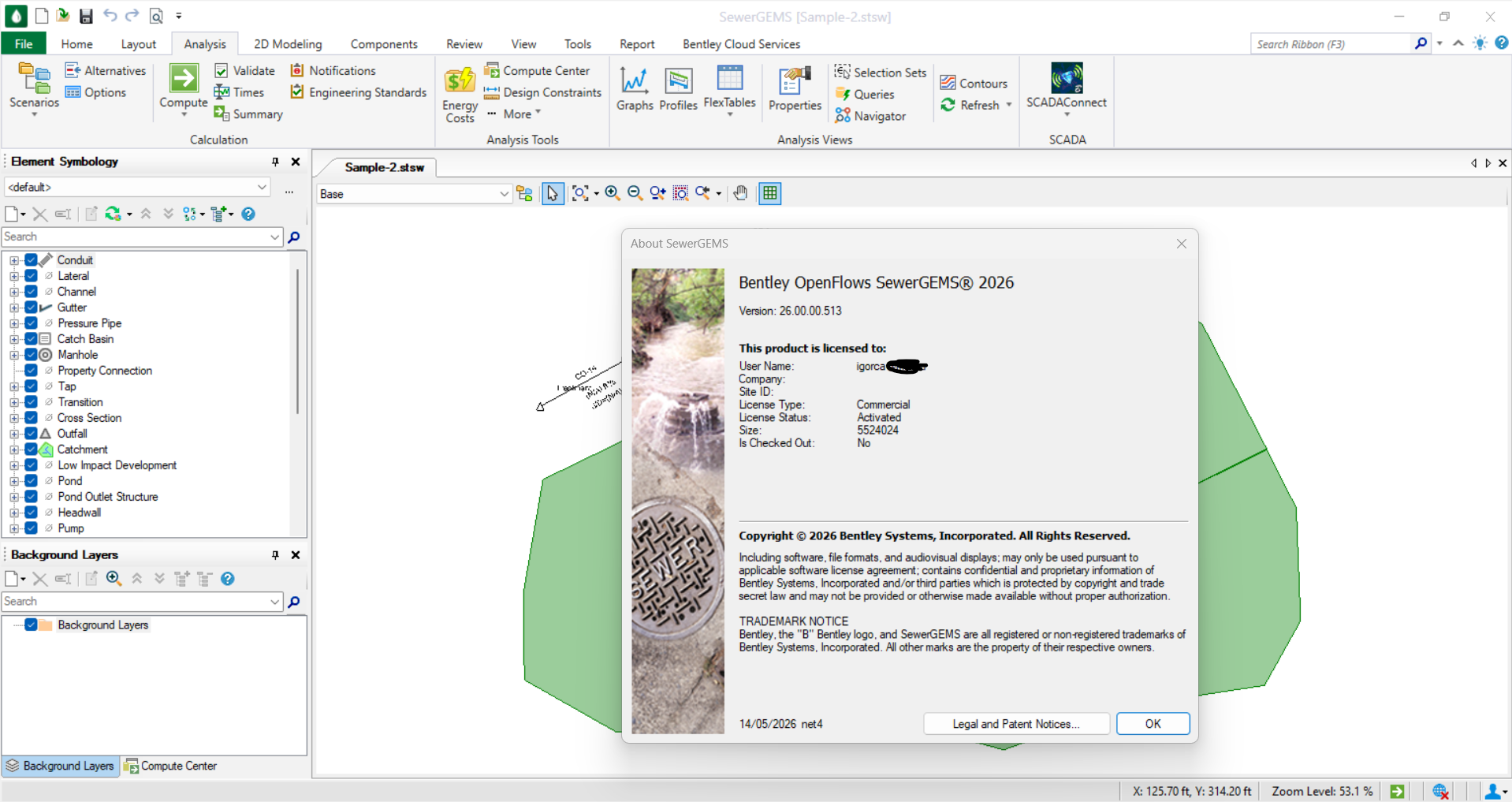
Bentley OpenFlows Sewer 26.00.00.513
Final Verdict
Bentley OpenFlows Sewer is a serious hydraulic modeling solution for professionals who need to understand, design, evaluate, and improve wastewater collection systems. Its strength lies in moving beyond isolated calculations and providing a broader view of how sewer networks behave as connected infrastructure systems.
For municipal planning, sewer capacity analysis, development studies, rehabilitation projects, and hydraulic investigations, the software can provide valuable engineering insight. Its scenario-based approach helps teams compare solutions before committing to expensive construction work, while network visualization makes complex systems easier to interpret.
The learning curve and professional licensing requirements may not appeal to casual users, but these are reasonable considerations for a platform designed for advanced infrastructure engineering.
For organizations managing complex sewer networks, Bentley OpenFlows Sewer is worth exploring as a powerful tool for hydraulic analysis, infrastructure planning, and data-driven wastewater system design. If your work involves understanding sewer capacity, investigating hydraulic problems, or planning future network improvements, evaluating Bentley OpenFlows Sewer could be a practical next step toward more confident and efficient engineering decisions.


Reviews
There are no reviews yet.