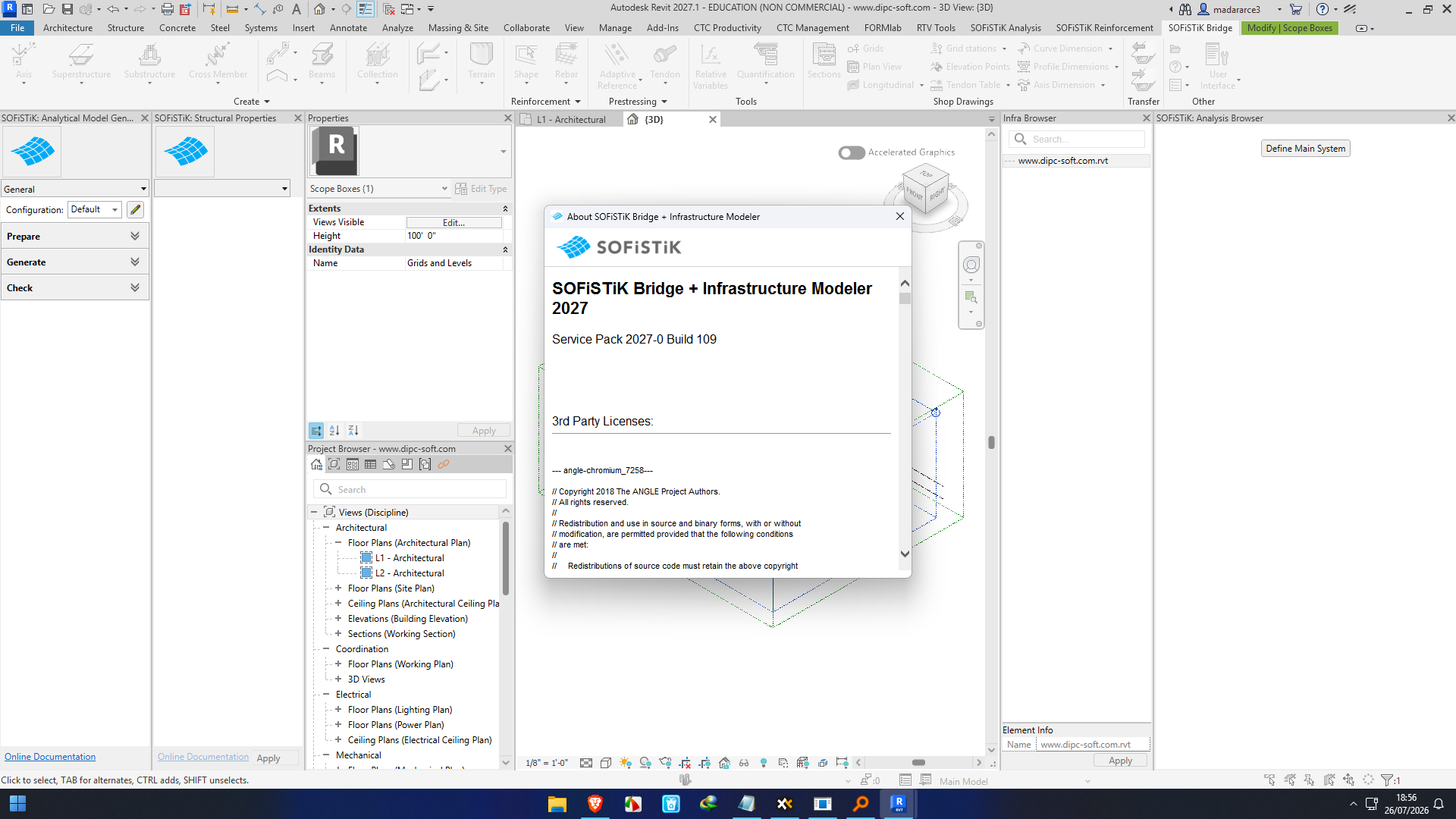
Description
SOFiSTiK Bridge + Infrastructure Modeler 2027: Advanced Engineering Design for Modern Infrastructure Projects
Summary
SOFiSTiK Bridge + Infrastructure Modeler is a specialized engineering software solution designed for structural analysis, modeling, and design of bridges and large-scale infrastructure systems. Built on advanced finite element methods and tightly integrated with leading CAD/BIM platforms, it enables engineers to develop highly accurate, regulation-compliant structural models with improved efficiency and reduced design errors.
In today’s infrastructure-driven world, where bridge safety, optimization, and cost efficiency are critical, this software stands out as a powerful tool for civil engineers, structural designers, and BIM specialists. It supports complex workflows ranging from conceptual modeling to detailed reinforcement design, making it a preferred choice in transportation infrastructure projects, highway bridge engineering, and railway structural analysis.
Introduction
Modern infrastructure projects demand precision, coordination, and compliance with strict engineering standards. Bridges, tunnels, and large transportation systems require tools that go beyond basic 3D modeling. This is where SOFiSTiK Bridge + Infrastructure Modeler plays a vital role.
Designed as part of the SOFiSTiK engineering ecosystem, this software combines structural analysis with BIM-based modeling to streamline bridge engineering workflows. It enables engineers to transition seamlessly from conceptual design to detailed construction documentation without losing accuracy or control over structural behavior.
Unlike generic modeling tools, SOFiSTiK focuses on engineering intelligence. It is widely used in Europe and globally for highway bridges, railway overpasses, pedestrian bridges, and complex infrastructure networks. Its strength lies in combining parametric modeling with advanced finite element analysis (FEA), ensuring that every structural decision is backed by engineering validation.
Key Features
SOFiSTiK Bridge + Infrastructure Modeler includes a wide range of features tailored specifically for infrastructure engineering projects.
1. Parametric Bridge Modeling
The software allows engineers to create parametric bridge models that can be easily adjusted. Span lengths, cross-sections, supports, and alignments can be modified without rebuilding the entire model.
2. BIM Integration
It integrates seamlessly with BIM platforms such as Autodesk Revit, enabling a smooth workflow between architectural design and structural engineering. This ensures consistency across disciplines.
3. Advanced Finite Element Analysis
The core strength of SOFiSTiK lies in its FEA capabilities. Engineers can simulate load distribution, stress behavior, deflection, and dynamic responses under real-world conditions.
4. Automated Design Standards Compliance
The software supports international design codes, including Eurocode standards. It automatically checks compliance, reducing manual verification effort and minimizing human error.
5. Infrastructure Modeling Tools
Specialized tools for modeling bridges, tunnels, and highways help streamline complex geometry creation. These tools are optimized for long-span structures and curved alignments.
6. Load Case Management
Engineers can define and manage multiple load cases, including traffic loads, wind pressure, seismic activity, and temperature variations.
7. Reinforcement Design and Detailing
The system supports detailed reinforcement design, including rebar placement, quantity estimation, and construction-ready documentation.
8. Automation and Scripting Support
Advanced users can automate repetitive tasks using scripting tools, improving productivity in large infrastructure projects.
Practical Use Cases
SOFiSTiK Bridge + Infrastructure Modeler is widely used in real-world engineering environments. Its applications span multiple infrastructure domains.
Highway Bridge Design
Engineering firms use the software to design multi-span highway bridges with complex load requirements. It helps optimize material usage while ensuring structural safety.
Railway Infrastructure Projects
Rail bridges require high precision due to dynamic loading conditions. SOFiSTiK allows engineers to simulate train loads and vibration impacts accurately.
Urban Overpasses and Flyovers
In dense urban environments, space constraints demand efficient design solutions. The software helps engineers create compact yet structurally sound overpasses.
Pedestrian and Footbridges
Architectural flexibility combined with structural validation allows designers to create aesthetically pleasing pedestrian bridges without compromising safety.
Large Infrastructure Networks
For mega projects involving multiple bridges and interchanges, SOFiSTiK enables coordinated modeling across different structural systems.
Rehabilitation and Retrofitting Projects
The software is also used to assess existing bridge conditions and design strengthening solutions for aging infrastructure.
Performance Analysis
From a performance standpoint, SOFiSTiK Bridge + Infrastructure Modeler is optimized for handling complex computational tasks and large-scale structural models.
Accuracy and Reliability
The software is highly regarded for its precision in structural calculations. Engineers trust its FEA engine for critical infrastructure decisions.
Efficiency in Workflow
Integration with BIM platforms reduces duplication of work. Changes made in the model are automatically reflected across analysis and documentation stages.
Learning Curve
While powerful, the software has a moderate to steep learning curve. Engineers with prior knowledge of structural analysis tools adapt more quickly.
Scalability
It performs well in both small bridge projects and large infrastructure networks. Its parametric nature ensures scalability without performance degradation.
Collaboration Support
The BIM-based workflow allows multiple disciplines to collaborate effectively, reducing communication gaps between architects, structural engineers, and contractors.
Pros and Cons
Pros
- Highly accurate structural analysis using advanced FEA
- Strong BIM integration with major design platforms
- Efficient parametric modeling for complex bridge structures
- Supports international design codes including Eurocode
- Suitable for both design and analysis workflows
- Excellent for large-scale infrastructure projects
- Automation capabilities for repetitive engineering tasks
Cons
- Requires strong technical background in structural engineering
- Learning curve can be steep for beginners
- High system requirements for large models
- Not suitable for general-purpose 3D modeling outside infrastructure engineering
Pricing and Plans
SOFiSTiK Bridge + Infrastructure Modeler is typically offered as part of the broader SOFiSTiK software ecosystem. Pricing may vary depending on licensing type, region, and project scale.
Common Licensing Models
- Commercial License: Designed for engineering firms and infrastructure companies
- Academic License: Available for universities and research institutions
- Project-Based Licensing: Used for large infrastructure projects with defined timelines
- Subscription Model: Annual licensing for continuous updates and support
While exact pricing is not publicly standardized, it is positioned as a professional-grade engineering solution rather than a low-cost design tool. The investment is generally justified by improved accuracy, reduced design errors, and faster project delivery.
SOFiSTiK Bridge + Infrastructure Modeler Developer
SOFiSTiK Bridge + Infrastructure Modeler 2027 Service Pack 2027-0 Build 109
Final Verdict
SOFiSTiK Bridge + Infrastructure Modeler is a powerful and highly specialized engineering tool built for modern infrastructure demands. It is not a general modeling software but a precision-driven platform tailored for bridge engineers, structural analysts, and BIM professionals working on complex transportation systems.
Its strongest advantage lies in combining parametric modeling, advanced finite element analysis, and BIM integration into a single workflow. This reduces design fragmentation and ensures that every stage of a project is structurally validated and documentation-ready.
Although it requires technical expertise and comes with a learning curve, the long-term benefits in accuracy, efficiency, and scalability make it a valuable asset for serious engineering firms.
For organizations involved in bridge design, infrastructure development, or large-scale civil engineering projects, SOFiSTiK Bridge + Infrastructure Modeler offers a reliable and future-ready solution that aligns with modern digital engineering standards.
Conclusion
SOFiSTiK Bridge + Infrastructure Modeler stands as a high-end solution for infrastructure professionals seeking precision, automation, and BIM-integrated workflows. Its ability to handle complex structural systems while maintaining design accuracy makes it a strong choice for engineering teams focused on efficiency and compliance.
For firms aiming to improve bridge design quality, reduce manual calculation errors, and streamline infrastructure workflows, exploring this software can significantly enhance project outcomes and engineering productivity.



Reviews
There are no reviews yet.