Description
Deltares D-Sheet Piling Review: Advanced Sheet Pile Design Software for Geotechnical Engineers
When designing sheet pile walls, accuracy is not optional. A small mistake in soil parameters, groundwater conditions, anchoring, or structural assumptions can significantly affect the safety and cost of a project. This is where Deltares D-Sheet Piling becomes a valuable tool for geotechnical engineers, civil engineers, consultants, and foundation specialists. Developed for advanced sheet pile and retaining wall analysis, the software helps professionals evaluate stability, structural forces, deformation behavior, and design performance in complex soil and water conditions.
In practical engineering work, sheet pile design often involves more than simply selecting a wall profile. Engineers must consider soil layers, excavation stages, water pressures, surcharge loads, anchors, struts, construction sequences, and applicable design standards. Deltares D-Sheet Piling brings these factors together in a structured calculation environment, helping users move from complicated geotechnical data to clearer engineering decisions.
This review explores the main features, practical applications, performance, advantages, limitations, and pricing considerations of Deltares D-Sheet Piling v. Whether you are working on excavation support, quay walls, flood protection, or temporary retaining structures, this software offers a specialized approach to sheet pile wall analysis and design.
Introduction
Sheet pile walls are widely used in construction, infrastructure, coastal engineering, and water management. They provide an efficient solution for retaining soil, supporting excavations, protecting riverbanks, and constructing marine structures. However, their performance depends heavily on the interaction between the wall, soil, groundwater, and applied loads.
Traditional hand calculations and spreadsheet-based workflows can become difficult to manage when a project includes multiple soil layers, staged excavation, groundwater changes, anchors, or complicated loading conditions. This is one of the main reasons specialized geotechnical engineering software has become an important part of modern design workflows.
Deltares D-Sheet Piling is designed specifically for sheet pile wall analysis. It supports engineers in evaluating the behavior of retaining structures under different loading and construction conditions. Rather than relying on simplified calculations alone, users can develop a more detailed representation of the project and analyze how the wall responds to changing conditions.
For engineers who regularly work with retaining walls and geotechnical structures, the software can help improve efficiency, reduce repetitive calculations, and provide a more organized design process.
What Is Deltares D-Sheet Piling?
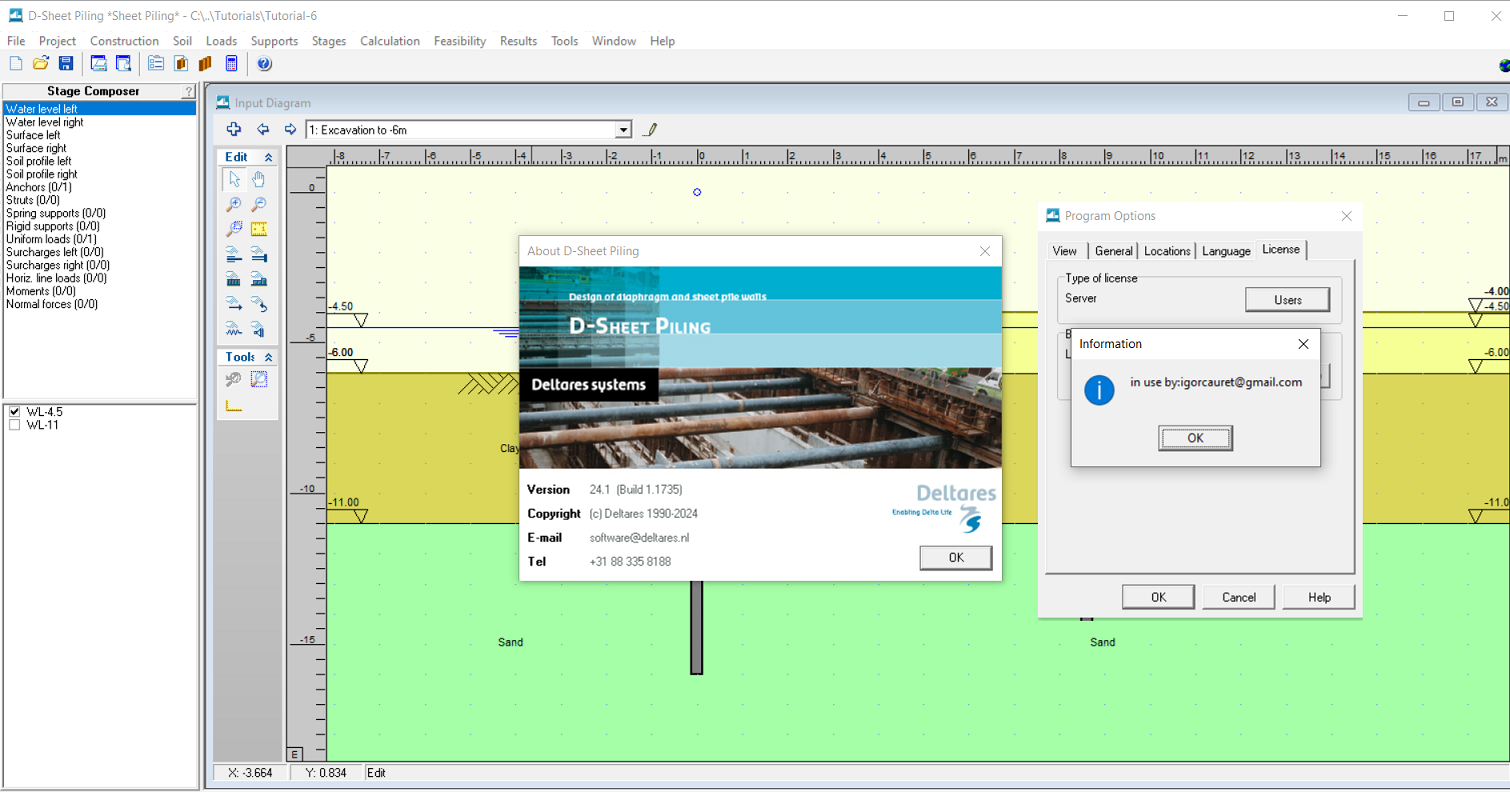
Deltares D-Sheet Piling v24.1 is a specialized geotechnical analysis solution for designing and assessing sheet pile walls and similar retaining structures. Its main purpose is to help engineers investigate the interaction between structural elements and the surrounding ground.
The software is particularly useful for projects involving:
- Sheet pile retaining walls
- Excavation support systems
- Anchored and propped walls
- Quay walls and waterfront structures
- Temporary construction support
- Flood defense and water management structures
- Deep excavations
- Soil-retaining systems with complex groundwater conditions
A typical project may require an engineer to model the ground profile, define soil properties, establish water levels, apply loads, and analyze the resulting wall behavior. D-Sheet Piling helps organize these design parameters into a consistent engineering workflow.
The result is a more practical way to examine structural forces, soil reactions, stability conditions, and design requirements before construction begins.
Key Features of Deltares D-Sheet Piling
1. Dedicated Sheet Pile Wall Analysis
One of the biggest advantages of D-Sheet Piling is its specialized focus. Instead of being a general-purpose structural program, it is built around geotechnical retaining wall problems.
This focused approach makes it suitable for engineers who need to assess:
- Bending moments
- Shear forces
- Wall stability
- Soil resistance
- Anchor forces
- Support reactions
- Excavation stages
For a sheet pile design engineer, having these calculations in one dedicated environment can be much more efficient than combining several independent tools.
2. Detailed Soil and Groundwater Modeling
Ground conditions are rarely uniform in real construction projects. A site may contain sand, clay, gravel, fill, soft soil, or layered deposits with different engineering characteristics.
Deltares D-Sheet Piling allows engineers to work with different soil conditions and groundwater scenarios. This is important because water pressure can have a major influence on the performance of a retaining wall.
A change in groundwater level can affect:
- Lateral earth pressure
- Effective stress
- Soil resistance
- Wall stability
- Structural forces
By considering these factors during the analysis stage, engineers can develop a more realistic understanding of the design.
3. Staged Construction Analysis
Construction sequence is often one of the most important aspects of retaining wall design. A wall may behave differently during initial installation, excavation, anchoring, and final construction.
D-Sheet Piling supports staged analysis, allowing users to evaluate how the system changes throughout the construction process.
For example, an engineer may analyze:
- Initial ground conditions
- Sheet pile installation
- Excavation to the first level
- Installation of anchors or struts
- Further excavation
- Final construction condition
This approach can provide a better understanding of the critical stage of a project rather than focusing only on the final condition.
4. Anchored and Supported Retaining Systems
Many sheet pile walls use anchors, walers, struts, or other support systems. These elements influence how forces are distributed through the wall.
The software can be useful for evaluating supported retaining structures and understanding how support locations affect:
- Wall deflection
- Bending moments
- Anchor loads
- Soil pressure distribution
This is especially valuable for deep excavation projects where a free-standing sheet pile wall may not be practical.
5. Engineering Reports and Calculation Results
A professional design is not complete without clear documentation. Engineers need to communicate assumptions, calculation results, design conditions, and safety checks to clients, reviewers, contractors, and regulatory authorities.
A major benefit of specialized engineering software is the ability to organize calculation results into a more structured format. This can make design review easier and help users maintain better documentation throughout a project.
Practical Use Cases
Deep Excavation Projects
Urban construction often requires excavation close to existing buildings, roads, utilities, and neighboring properties. Sheet pile walls can provide temporary or permanent support during excavation.
In such cases, engineers need to understand how the wall will respond as soil is removed. D-Sheet Piling can help analyze excavation stages and evaluate the effect of support systems.
For example, a construction team working on an underground parking structure may need to determine whether a sheet pile wall can safely support the excavation at different depths. Modeling each construction stage can provide valuable design information before work begins.
Waterfront and Quay Structures
Sheet piles are commonly used in marine construction and waterfront infrastructure. These projects can involve complicated water levels, tidal changes, surcharge loads, and different soil conditions.
Engineers designing quay walls and riverbank structures can use a dedicated sheet pile analysis workflow to evaluate the effects of soil and water pressure on the wall.
Flood Protection and Water Management
Flood defense structures often require retaining systems that can withstand changing water levels and soil pressures. The ability to assess groundwater and water-related loading conditions makes specialized geotechnical analysis particularly useful in these projects.
D-Sheet Piling can support the evaluation of retaining structures used in channels, embankments, flood protection works, and water management infrastructure.
Temporary Construction Support
Not every sheet pile wall is designed to remain permanently. Temporary excavation support systems must still be carefully designed because failure during construction can create serious safety and financial consequences.
Engineers can use staged analysis to evaluate temporary conditions and determine how the wall performs during excavation and support installation.
Consulting and Design Offices
For geotechnical consultants handling multiple retaining wall projects, a dedicated analysis program can improve workflow consistency. Instead of building a new spreadsheet model for every project, engineers can follow a more structured process.
This can help reduce repetitive work and make it easier to compare design alternatives.
Performance Analysis
From a practical engineering perspective, the main strength of Deltares D-Sheet Piling is its specialization. Software designed specifically for sheet pile and retaining wall problems can be easier to apply than a general structural analysis package when the project falls directly within its intended scope.
The software is particularly useful when projects include multiple construction stages or changing groundwater conditions. These situations can become difficult to manage manually, especially when several design alternatives must be tested.
A typical user experience may involve starting with a basic soil profile and then progressively adding project complexity. An engineer might first examine a simple free-standing wall, then introduce excavation, water levels, anchors, and surcharge loads. This allows the designer to understand how each factor changes the design.
Performance also depends heavily on the quality of the input data. No software can compensate for incorrect soil parameters or unrealistic groundwater assumptions. Engineers must still use professional judgment and reliable site investigation information.
The best results are achieved when the software is used as part of a complete geotechnical design process that includes:
- Proper site investigation
- Reliable soil parameters
- Appropriate groundwater assumptions
- Correct loading conditions
- Engineering judgment
- Independent design review when required
User Experience and Learning Curve
For experienced geotechnical engineers, the specialized nature of D-Sheet Piling can be a significant advantage. The workflow is centered on retaining wall design rather than unrelated structural functions.
New users may need time to understand the software’s modeling approach, especially if they are unfamiliar with staged geotechnical analysis. The learning curve is generally connected to understanding engineering concepts rather than simply learning buttons and menus.
Users who already understand:
- Earth pressure theory
- Soil parameters
- Sheet pile behavior
- Excavation staging
- Groundwater effects
will likely find it easier to develop reliable models.
For beginners, the best approach is to start with simple examples before attempting complicated real-world projects. Building a model step by step can help users understand how changes in soil layers, excavation levels, or support systems affect the final results.
Pros and Cons
Pros
- Specialized for sheet pile and retaining wall analysis
- Useful for complex geotechnical design conditions
- Supports staged construction analysis
- Helps evaluate soil and groundwater interaction
- Suitable for anchored and supported retaining systems
- Useful across excavation, waterfront, and flood protection projects
- Can improve consistency in professional design workflows
- Helps reduce dependence on repetitive manual calculations
Cons
- May require geotechnical engineering knowledge to use effectively
- Advanced analysis can have a learning curve for new users
- Software results depend strongly on the quality of input parameters
- May be more specialized than users need for simple retaining wall calculations
- Licensing and availability should be confirmed for the specific version and user requirements
Pricing and Plans
Pricing for Deltares D-Sheet Piling may depend on the licensing model, edition, organization type, and current availability. Professional engineering software is often offered through commercial licensing arrangements, institutional agreements, or specialized distribution channels.
Because pricing and license terms can change, users should verify the current cost, supported operating environment, update policy, and technical support options before purchasing.
When evaluating the total value of the software, it is also important to consider the time saved during design development and review. For an engineering office that frequently handles sheet pile walls, a specialized design solution may provide greater long-term value than relying entirely on manual calculations or disconnected spreadsheets.
Deltares D-Sheet Piling Developer
Final Verdict
Deltares D Sheet Piling is a strong specialized solution for engineers who regularly design and analyze sheet pile walls, retaining systems, excavation support, and waterfront structures. Its greatest advantage is its focused approach to geotechnical retaining wall problems.
The software is especially valuable when a project includes layered soil conditions, groundwater interaction, staged excavation, anchors, or other design complexities. Instead of treating the wall as an isolated structural element, engineers can investigate its behavior in relation to the surrounding ground and construction sequence.
For beginners, the software may require time and engineering knowledge to master. However, professionals who understand geotechnical design principles can benefit from a more organized and efficient workflow.
If your work involves sheet pile wall design, excavation support, flood protection, or marine construction, exploring Deltares DSheet Piling can be a practical step toward improving design efficiency and analysis quality. The software is best used with accurate site data, sound engineering judgment, and appropriate design standards. When those elements come together, it can become a valuable part of a modern geotechnical engineering toolkit.




Reviews
There are no reviews yet.