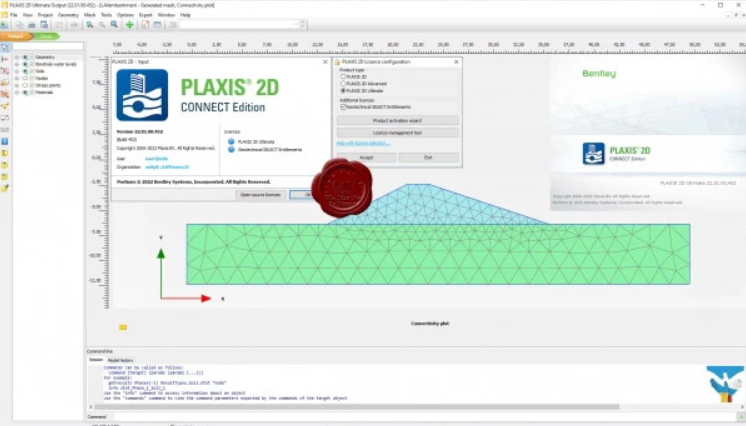
Description
PLAXIS 2D Review – Advanced Geotechnical Engineering Software for Soil and Foundation Analysis
In modern civil engineering and geotechnical design, precision is not optional—it’s essential. Whether you’re designing deep foundations, analyzing slope stability, or simulating soil-structure interaction, having reliable software can make the difference between a safe structure and a costly failure. PLAXIS 2D has established itself as one of the most trusted finite element analysis tools for geotechnical engineers worldwide.
Developed by Bentley Systems, PLAXIS 2D is purpose-built for soil and rock mechanics simulations. It allows engineers to model complex geotechnical problems with high accuracy using advanced numerical methods. From infrastructure mega-projects to everyday foundation design, PLAXIS 2D plays a critical role in safe and efficient engineering.
In this comprehensive review, we’ll explore PLAXIS 2D’s features, real-world applications, performance, pros and cons, pricing insights, and why it remains a leading solution for geotechnical analysis.
Introduction to PLAXIS 2D
PLAXIS 2D is a specialized geotechnical engineering software that uses finite element methods (FEM) to simulate soil behavior and structural interactions. Unlike general-purpose engineering tools, PLAXIS 2D focuses specifically on:
- Soil mechanics
- Foundation engineering
- Excavation analysis
- Groundwater flow
- Slope stability
It enables engineers to create realistic models of subsurface conditions and evaluate how soils and structures behave under various loads and environmental conditions.
For professionals searching for advanced geotechnical simulation software, PLAXIS 2D is widely considered an industry standard.
Key Features of PLAXIS 2D
1. Finite Element Modeling for Soil and Structures
At its core, PLAXIS 2D uses advanced FEM techniques to simulate real-world conditions.
Users can:
- Model layered soil profiles
- Define complex geometries
- Analyze stress and deformation
- Simulate construction stages
This provides highly accurate results for engineering decision-making.
2. Advanced Soil Material Models
Soil behavior is complex and nonlinear. PLAXIS 2D includes a wide range of material models such as:
- Mohr-Coulomb model
- Hardening Soil model
- Soft Soil model
- User-defined advanced material models
These models allow engineers to simulate realistic soil responses under different conditions.
3. Staged Construction Simulation
Construction projects occur in phases, and PLAXIS 2D allows users to simulate each stage.
This includes:
- Excavation sequences
- Loading and unloading conditions
- Installation of retaining structures
- Time-dependent effects
This feature is essential for understanding how construction activities impact soil stability.
4. Groundwater Flow and Coupled Analysis
Water plays a major role in geotechnical behavior.
PLAXIS 2D supports:
- Seepage analysis
- Pore pressure calculations
- Coupled flow-deformation analysis
This helps engineers evaluate risks related to water pressure and drainage conditions.
5. Structural Elements Integration
PLAXIS 2D allows integration of structural components such as:
- Retaining walls
- Piles and anchors
- Geotextiles and reinforcements
- Tunnel linings
This enables detailed soil-structure interaction analysis.
6. Mesh Generation and Visualization Tools
The software provides powerful tools for:
- Automatic mesh generation
- Mesh refinement
- Contour plotting
- Deformation visualization
Clear visual outputs make it easier to interpret results and communicate findings.
Practical Use Cases of PLAXIS 2D
1. Foundation Design for Buildings
A structural engineer designing a high-rise building must ensure the foundation can handle loads safely.
Using PLAXIS 2D:
- Soil layers are modeled
- Load conditions are applied
- Settlement and stress distribution are analyzed
This ensures the foundation design meets safety and performance requirements.
2. Slope Stability Analysis
In hilly or mountainous regions, slope stability is critical.
Engineers can:
- Model slope geometry
- Simulate rainfall and groundwater effects
- Calculate factor of safety
This helps prevent landslides and ensures safe construction.
3. Excavation and Retaining Structures
Urban construction often involves deep excavations.
PLAXIS 2D allows engineers to:
- Simulate excavation stages
- Design retaining walls and anchors
- Evaluate ground movement
This minimizes risks to nearby structures.
4. Tunnel Engineering
Tunnel projects require detailed subsurface analysis.
With PLAXIS 2D:
- Soil and rock conditions are modeled
- Tunnel lining behavior is analyzed
- Ground deformation is predicted
This ensures safe and efficient tunnel construction.
5. Embankment and Road Design
Transportation projects often involve embankments.
Engineers use PLAXIS 2D to:
- Analyze soil settlement
- Evaluate stability under traffic loads
- Optimize design parameters
This improves long-term performance of infrastructure.
Performance Analysis
User Interface and Workflow
PLAXIS 2D offers a structured and professional interface.
Key highlights:
- Dedicated modules for input, calculation, and output
- Logical workflow for model setup
- Visual modeling environment
Although beginners may need training, experienced users benefit from its precision and control.
Speed and Processing Efficiency
Performance depends on model complexity and hardware.
- Efficient for standard geotechnical models
- Handles complex simulations with proper hardware
- Reliable calculation engine
For large-scale projects, high-performance systems are recommended.
Accuracy and Reliability
Accuracy is a defining strength of PLAXIS 2D.
- Advanced algorithms ensure realistic results
- Widely validated in engineering practice
- Trusted for high-risk projects
This reliability makes it a preferred choice for critical infrastructure design.
Pros and Cons of PLAXIS 2D
Pros
- Industry-standard geotechnical analysis software
- Advanced soil material models
- Detailed staged construction simulation
- Strong groundwater analysis capabilities
- Accurate soil-structure interaction modeling
- High-quality visualization tools
Cons
- Steep learning curve for beginners
- Requires powerful hardware for complex models
- Premium pricing for full-feature licenses
Despite these drawbacks, its capabilities far outweigh the limitations for professional use.
Pricing & Plans
PLAXIS 2D is offered under a commercial licensing model, typically including:
- Subscription-based licenses
- Perpetual license options
- Additional modules for advanced features
- Maintenance and support packages
Pricing varies depending on the level of functionality and organizational requirements.
For engineering firms, it is considered a long-term investment in safety and design accuracy.
Why PLAXIS 2D Stands Out in Geotechnical Software
PLAXIS 2D remains a leader in geotechnical engineering software due to:
- Specialized focus on soil mechanics
- Advanced simulation capabilities
- Strong industry adoption
- Continuous updates and improvements
It provides a level of detail and accuracy that general-purpose tools cannot match.
EEAT Perspective: Why Engineers Trust PLAXIS 2D
PLAXIS 2D aligns strongly with professional standards:
- Experience: Used in real-world engineering projects globally
- Expertise: Designed specifically for geotechnical analysis
- Authority: Recognized as a leading FEM tool in civil engineering
- Trust: Reliable results for safety-critical decisions
Offering PLAXIS 2D in your software store demonstrates credibility and commitment to professional-grade solutions.
Final Verdict: Is PLAXIS 2D Worth It?
PLAXIS 2D is more than just a simulation tool—it is a comprehensive geotechnical engineering platform that empowers professionals to design safer, more efficient structures.



Reviews
There are no reviews yet.