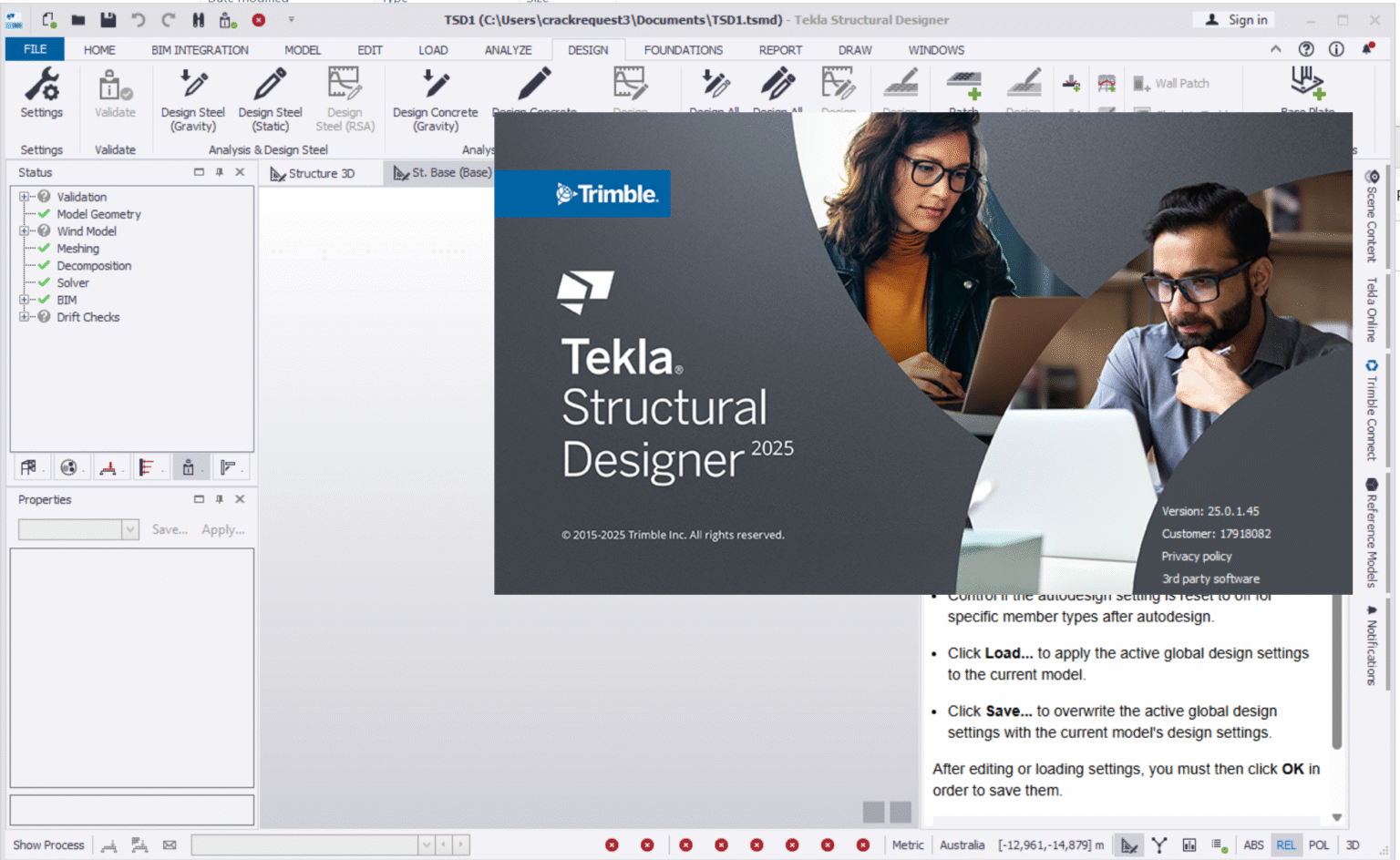
Description
Tekla Structures Software Review: Advanced BIM Solution for Structural Engineering and Construction Excellence
Strong Summary
Tekla Structures is widely recognized as one of the most powerful Building Information Modeling (BIM) solutions designed specifically for structural engineering, steel detailing, and construction project execution. Developed by Trimble, this software enables engineers, fabricators, and contractors to create highly detailed, data-rich 3D structural models that improve accuracy, coordination, and construction efficiency.
Unlike traditional CAD tools, Tekla Structures focuses on constructible models rather than just drawings. It allows users to design, analyze, and manage structures of all scales—from small industrial buildings to complex infrastructure projects such as bridges, stadiums, and high-rise towers. Its precision-driven workflow reduces errors, improves collaboration, and significantly enhances project delivery timelines.
For construction professionals seeking advanced steel detailing software or a complete BIM environment for structural modeling, Tekla Structures stands out as a top-tier industry solution.
Introduction
In modern construction, precision and coordination are critical. Projects today involve multiple disciplines working simultaneously, including architects, structural engineers, fabricators, and site teams. Any miscommunication can result in costly delays or rework.
Tekla Structures addresses this challenge by offering a unified BIM environment where all structural components are modeled with construction-level accuracy. It supports steel, concrete, timber, and hybrid structures, making it a versatile tool for diverse engineering needs.
What makes Tekla Structures particularly valuable is its ability to handle complex geometries while maintaining fabrication-level detail. This means that every bolt, weld, reinforcement bar, and connection is accurately represented and can be directly used for construction and manufacturing.
Key Features of Tekla Structures
Tekla Structures is equipped with advanced capabilities that make it a leader in structural BIM software.
1. Highly Detailed 3D Modeling
- Create precise 3D structural models
- Support for steel, concrete, and timber structures
- Accurate representation of real-world construction elements
2. Construction-Ready Detailing
- Fabrication-level accuracy for steel detailing
- Automatic generation of shop drawings
- Detailed reinforcement modeling for concrete structures
3. Multi-Material Support
- Steel structures with complex connections
- Reinforced concrete modeling
- Timber construction support
- Hybrid structural systems
4. Advanced Collaboration Tools
- Real-time model sharing
- Multi-user environment for large teams
- Integration with cloud-based workflows
5. Interoperability with BIM Tools
- Compatible with IFC standard formats
- Integration with Autodesk Revit, AutoCAD, and other BIM platforms
- Seamless data exchange across disciplines
6. Automated Drawing and Reporting
- Generates GA drawings automatically
- Material takeoff (BOQ) reports
- Accurate fabrication reports
7. Clash Detection and Error Reduction
- Detects design conflicts early
- Reduces on-site construction errors
- Improves coordination between teams
8. Customizable Workflows
- User-defined components
- Custom parametric modeling tools
- Automation through templates and macros
Practical Use Cases
Tekla Structures is used across a wide range of construction and engineering applications.
1. High-Rise Buildings
In skyscraper projects, precision is essential. Tekla Structures allows engineers to model entire building frameworks, ensuring structural integrity and coordination between steel frames and concrete cores.
2. Industrial Facilities
Factories, warehouses, and power plants rely on steel-heavy designs. Tekla Structures enables detailed steel fabrication drawings and accurate material planning.
3. Bridges and Infrastructure
For complex bridge designs, Tekla supports curved geometries, tension systems, and reinforcement detailing, making it suitable for civil engineering infrastructure.
4. Precast Concrete Projects
Precast manufacturers benefit from automated reinforcement detailing and panelization tools, improving production efficiency.
5. Fabrication Shops
Steel fabricators use Tekla Structures to generate precise shop drawings, reducing manual interpretation errors and speeding up production.
6. Construction Coordination
Contractors use the software to visualize entire projects before construction begins, identifying issues early and optimizing construction sequencing.
Performance Analysis
Tekla Structures is known for its high-performance modeling capabilities, especially when dealing with large and complex projects.
Strengths in Performance
- Handles large-scale models with millions of components
- Stable performance in multi-user environments
- Efficient rendering of complex steel connections
- Reliable data management for BIM workflows
Learning Curve
While powerful, Tekla Structures has a relatively steep learning curve. Beginners may find it complex due to its advanced detailing features and engineering-focused interface. However, once mastered, it significantly improves productivity.
Accuracy and Precision
One of the strongest aspects of Tekla Structures is its unmatched accuracy. Every structural component is modeled in real-world detail, which reduces errors during fabrication and construction.
Collaboration Efficiency
With strong BIM integration, teams across disciplines can collaborate effectively, reducing miscommunication and improving project delivery timelines.
Pros and Cons
Pros
- Extremely accurate structural modeling
- Industry-leading steel detailing capabilities
- Excellent BIM collaboration support
- Strong automation for drawings and reports
- Supports complex geometries and large-scale projects
- Reliable for fabrication and construction workflows
Cons
- High learning curve for beginners
- Requires powerful hardware for large models
- Premium pricing may not suit small firms
- Interface can feel complex compared to simpler CAD tools
Pricing and Plans
Tekla Structures is typically offered through subscription-based licensing, with pricing depending on region, module selection, and usage requirements.
Common licensing models include:
- Monthly subscription plans
- Annual enterprise licenses
- Educational versions for students and institutions
- Industry-specific configurations for steel, concrete, or general BIM use
While exact pricing varies, Tekla Structures is generally considered a high-end professional solution, targeted at engineering firms, contractors, and large-scale construction companies.
Organizations often choose Tekla because of its long-term cost efficiency. Even though initial investment is higher, the reduction in errors, material waste, and rework leads to significant project savings.
Final Verdict
Tekla Structures stands as a benchmark in structural BIM software and steel detailing technology. Its ability to create highly accurate, construction-ready models makes it an essential tool for modern engineering and construction workflows.
For professionals working in structural engineering, fabrication, or large-scale infrastructure development, Tekla Structures offers unmatched precision, advanced modeling capabilities, and strong collaboration features.
Although it requires time to master and a robust system to run efficiently, the long-term benefits far outweigh the challenges. It improves project coordination, reduces costly mistakes, and enhances overall construction efficiency.
In an industry where accuracy and speed define success, Tekla Structures delivers a reliable and future-ready BIM environment.
For organizations aiming to upgrade their structural design and construction workflows, exploring Tekla Structures is a strategic step toward greater efficiency, accuracy, and professional excellence.




Reviews
There are no reviews yet.